





 SIMPL - School
Information Management Portal
 WINGS - Placement portal
 eNABLE - HR solution
 ALMA DRIVE - Alumni Portal

AI tools for digital marketing are no longer a future trend. Busy marketing teams use them every day to work faster and smarter.
Think keyword research in minutes, ad copy in seconds and reports that almost build themselves.
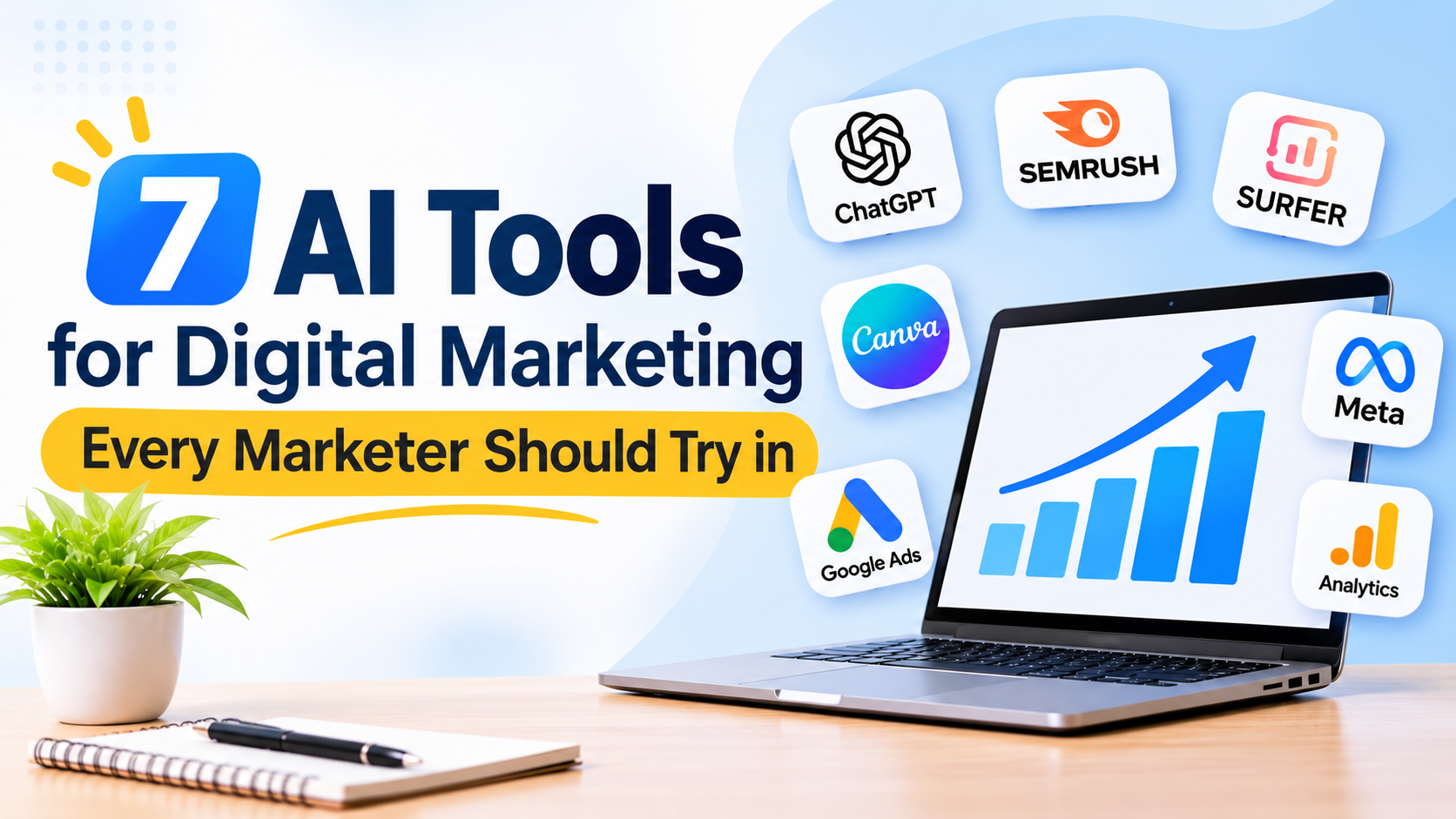
In this guide, we picked 7 AI tools for digital marketers that cover SEO, content, social media, ads, automation and analytics.
No hype, just tools we would trust on a live client account. Let’s get into it.
Why AI-Driven Marketing Is Now the Standard
Artificial intelligence has become an important part of modern marketing workflows. From content creation and keyword research to campaign optimization and customer engagement, AI is helping marketing teams handle repetitive tasks more efficiently.
Here are some ways AI is changing marketing:
- Speed: Generate content drafts, ad variations and campaign reports more quickly.
- Personalization: Create more relevant messages based on customer interests and behaviour.
- Prediction: Analyze available data to identify potential customer actions and campaign opportunities.
- Automation: Reduce repetitive tasks through automated workflows and campaign management.
AI can improve efficiency, but it cannot replace strategic thinking, creativity and an understanding of customer needs. The best results come from combining technology with human expertise.
How We Picked the Best AI Tools for Digital Marketing
With hundreds of AI-powered platforms available, choosing the right solution can be challenging. We focused on tools that offer practical features and address common marketing requirements.
Each tool was considered based on five factors:
- Practical usefulness: Does it solve a regular marketing task?
- Ease of use: Can marketers learn and use its main features without extensive technical knowledge?
- Accessibility: Does it offer a free plan, trial or flexible pricing?
- Data security: Does it provide suitable privacy and data protection options?
- Output quality: Can marketers use its results effectively after reviewing and refining them?
These considerations help identify solutions that offer practical value rather than simply following AI trends.
7 AI Tools for Digital Marketers Worth Your Time
1. ChatGPT: AI Content Creation Tools for Faster First Drafts
ChatGPT can help marketers overcome writer’s block and speed up content production. However, AI-generated drafts should always be reviewed before publishing.
Add original insights, relevant examples, accurate information and subject expertise to make the content genuinely useful. Google’s guidance emphasizes helpful, reliable and people-first content rather than rewarding content simply because it is written by humans or AI.
- Best for: Blog outlines, content ideas, email copy, FAQs and advertising headlines.
- Pro tip: Provide clear instructions, audience details, brand guidelines and relevant information to get more useful outputs.
2. Semrush: AI Tools for SEO That Cut Research Time
Keyword research used to eat half a day. Now it takes minutes.
Semrush combines keyword research tools, competitor gap analysis and AI-assisted content ideas in one dashboard.
Among AI tools for SEO, it is the one we reach for when planning a new page or a full topic cluster.
- Best for: AI SEO tools and SEO automation, such as site audits and rank tracking
- Pro tip: Start with keywords where you rank on page two. Small updates can move them up.
3. Surfer SEO: Content Optimization Tools That Show What Ranks
Writing a good page is one thing. Matching what Google already rewards is another.
Surfer analyzes top-ranking pages and suggests terms, headings and length for your draft.
Think of it as one of the most practical content optimization tools for on-page work.
- Best for: Refreshing old blogs and optimizing service pages
- Pro tip: Use its score as a guide, not a goal. Never sacrifice readability for a number.
4. Canva Magic Studio: AI Tools for Social Media Marketing
Few AI tools for social media marketing are as beginner-friendly as Canva.
It turns a text prompt into designs, resizes posts across platforms and schedules them from the same workspace.
That makes social media content creation far quicker for small teams.
- Best for: Instagram carousels, LinkedIn banners and reels covers
- Pair it with: Buffer or Hootsuite. These social media automation tools handle AI social media management, such as scheduling and caption suggestions.
5. Meta Advantage+ and Google Performance Max: AI-Powered Advertising
Paid advertising platforms are increasingly using artificial intelligence to improve campaign management and performance.
Meta Advantage+ uses AI and automation to help advertisers optimize campaign delivery across Meta platforms. Google Performance Max uses Google’s AI to optimize advertising across its available channels, including Search, YouTube, Display, Discover, Gmail and Maps.
Both platforms offer automation capabilities, but their campaign structures, targeting options and optimization features are different.
- Best for: Automated campaign optimization, audience discovery, bidding and advertising performance.
- Pro tip: Provide relevant creatives, accurate conversion tracking and sufficient campaign data. Review performance regularly instead of relying entirely on automated recommendations.
Remember that automation does not guarantee conversions. Campaign performance still depends on your offer, audience, landing page, budget and conversion data.
6. HubSpot: AI Marketing Automation Tools for Smarter Workflows
Leads go cold when follow-ups are slow.
Among AI marketing automation tools, HubSpot stands out for connecting your CRM, email and content in one place.
It supports marketing workflow automation, lead scoring and automated marketing campaigns that react to user behavior.
- Best for: AI-powered customer engagement, like personalized emails and chat
- Pro tip: Automate one workflow first, such as a welcome sequence. Then expand.
7. Google Analytics 4: AI-Powered Digital Marketing Tools for Predictive Insights
Understanding customer behaviour is essential for improving marketing performance. Google Analytics 4 (GA4) helps marketers analyze website traffic, user interactions, conversions and audience behaviour.
It also offers predictive metrics, including purchase probability and churn probability, for eligible properties with sufficient data.
These insights can help marketers identify valuable audience segments and make more informed advertising decisions.
- Best for: Website performance analysis, conversion tracking, audience insights and marketing performance measurement.
- Pro tip: Configure your conversion events correctly and explore predictive audiences when your property meets Google’s eligibility requirements.
GA4 is primarily an analytics platform rather than a dedicated AI marketing tool, but its predictive capabilities make it a valuable addition to a modern marketing toolkit.
How to Choose the Right AI Tools for Digital Marketing
Not every marketing team needs every available AI platform. The right combination depends on your business goals, team size and existing marketing workflow.
Start by identifying the tasks that consume the most time or require improvement.
- For content creation: Use ChatGPT to generate ideas, outlines and initial drafts.
- For SEO research: Explore Semrush for keyword research, competitor analysis and website audits.
- For content optimization: Use Surfer SEO to improve content structure and on-page relevance.
- For social media design: Try Canva Magic Studio to create and adapt marketing creatives.
- For paid advertising: Explore Meta Advantage+ and Google Performance Max for campaign automation.
- For marketing automation: Use HubSpot to manage leads, email campaigns and customer interactions.
- For analytics: Use Google Analytics 4 to understand website performance and user behaviour.
Choose tools based on actual business requirements rather than adopting platforms simply because they are popular. Evaluate their features, costs and performance before expanding your marketing stack.
Digital Marketing Automation Tools: Build a Simple Workflow
Digital marketing automation tools work best when they connect to each other.
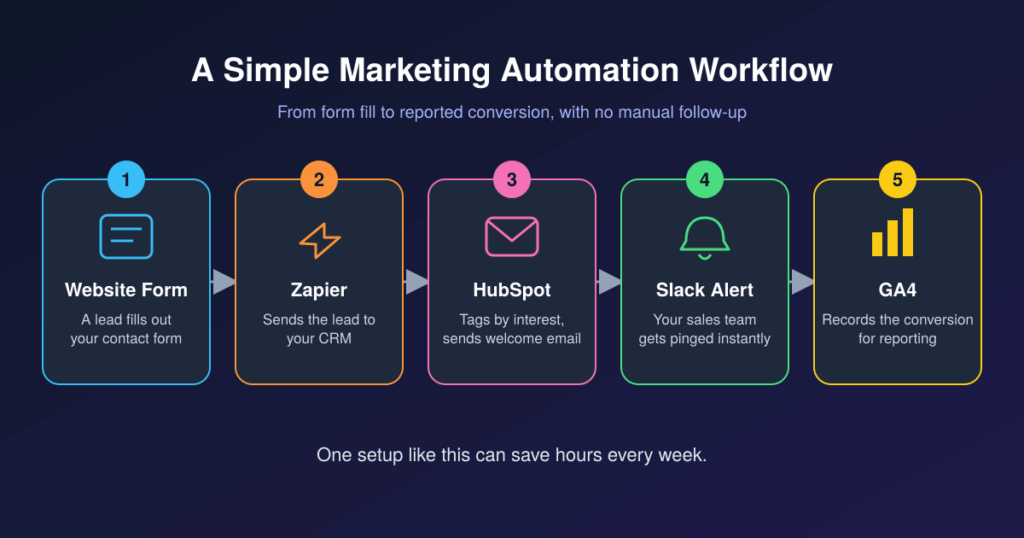
Tools like Zapier can link your forms, CRM and email platform without code.
Here is a simple starter workflow:
- A lead fills out your website form.
- Zapier sends the lead to HubSpot.
- HubSpot tags the lead by interest and sends a welcome email.
- A sales alert goes to your team on Slack.
- GA4 records the conversion for reporting.
One setup like this can save hours every week.
Best Practices for Using AI in Digital Marketing
Getting value from AI requires more than choosing the right software. Marketers also need a clear process for using these platforms responsibly.
Follow these practices to improve your results:
- Review AI-generated content: Check facts, grammar, originality and relevance before publishing.
- Add human expertise: Include real examples, industry knowledge and insights that automated tools may not provide.
- Protect customer information: Avoid sharing confidential business or client data without appropriate safeguards.
- Maintain brand consistency: Use clear brand guidelines, tone preferences and messaging instructions.
- Measure performance: Track productivity, engagement, conversions and other relevant marketing metrics.
- Understand tool limitations: AI-generated recommendations may require verification and human judgment.
- Follow platform policies: Understand the advertising, privacy and content guidelines of each platform you use.
AI should support your marketing strategy, not make every decision on your behalf.
Conclusion
The future of marketing will involve a closer combination of artificial intelligence, automation and human creativity.
The right AI tools for digital marketing can simplify repetitive tasks, support better decision-making and help marketing teams manage their workflows more efficiently.
However, choosing the right platforms is only the first step. Successful marketing still depends on understanding your audience, developing effective strategies and evaluating campaign performance.
Start with one or two tools that address your biggest challenges. Explore their features, measure the results and gradually build a workflow that supports your business goals.
Frequently Asked Questions
1. What are the best AI tools for digital marketing in 2027?
Some of the useful AI tools for digital marketing in 2027 include ChatGPT for content creation, Semrush for SEO research, Surfer SEO for content optimization, Canva Magic Studio for graphic design, Meta Advantage+ and Google Performance Max for advertising, HubSpot for marketing automation, and Google Analytics 4 for performance analysis.
2. Which AI tools are best for SEO and keyword research?
Semrush is useful for keyword research, competitor analysis and website audits, while Surfer SEO helps optimize website content. ChatGPT can also assist with keyword clustering, content ideas and SEO outlines. Marketers should validate keyword opportunities using reliable SEO data.
3. Can AI tools help improve website rankings on Google?
Yes, AI tools can support SEO activities such as keyword research, content planning, competitor analysis and content optimization. However, they cannot guarantee higher rankings. Website performance, helpful content, technical SEO, relevance and overall search quality remain important ranking considerations.
4. What are the best free AI tools for digital marketing?
ChatGPT, Canva, Google Analytics 4 and HubSpot offer free access options or plans with varying limitations. Some other platforms provide free trials or limited free features. Check their current pricing and plan restrictions before choosing a tool.
5. How can AI tools improve social media marketing?
AI tools can help generate content ideas, write captions, create graphics, suggest hashtags and streamline publishing workflows. Platforms such as Canva Magic Studio and ChatGPT can reduce content production time and help maintain a consistent social media presence.
6. How is AI changing Google Ads and Meta Ads campaigns?
AI is helping automate bidding, campaign delivery, audience discovery and performance optimization. Google Performance Max and Meta Advantage+ use machine learning to improve different aspects of advertising campaigns. Marketers still need to provide relevant creatives, accurate conversion tracking and effective campaign strategies.
7. Can AI automate digital marketing tasks?
Yes, AI and marketing automation platforms can simplify repetitive activities such as email follow-ups, lead management, content scheduling, reporting and customer communication. Tools like HubSpot and Zapier help connect different marketing processes and reduce manual work.
8. How can small businesses use AI tools for digital marketing?
Small businesses can use AI tools to create marketing content, research keywords, design social media posts, manage advertising campaigns and automate customer follow-ups. Starting with a few affordable tools that address immediate business needs is a practical approach.
9. Will AI replace digital marketing professionals in the future?
AI is more likely to transform marketing roles than completely replace marketing professionals. While automation can handle repetitive tasks, businesses still need human expertise for strategy, creativity, customer understanding, campaign planning and decision-making.
10. How should businesses choose the right AI marketing tools?
Businesses should evaluate AI tools based on their marketing objectives, features, ease of use, pricing, integration options, data security and scalability. Selecting tools that solve specific business challenges is more effective than adopting multiple platforms without a clear strategy.
