







 SIMPL - School
Information Management Portal
SIMPL - School
Information Management Portal WINGS - Placement portal
 eNABLE - HR solution
 ALMA DRIVE - Alumni Portal

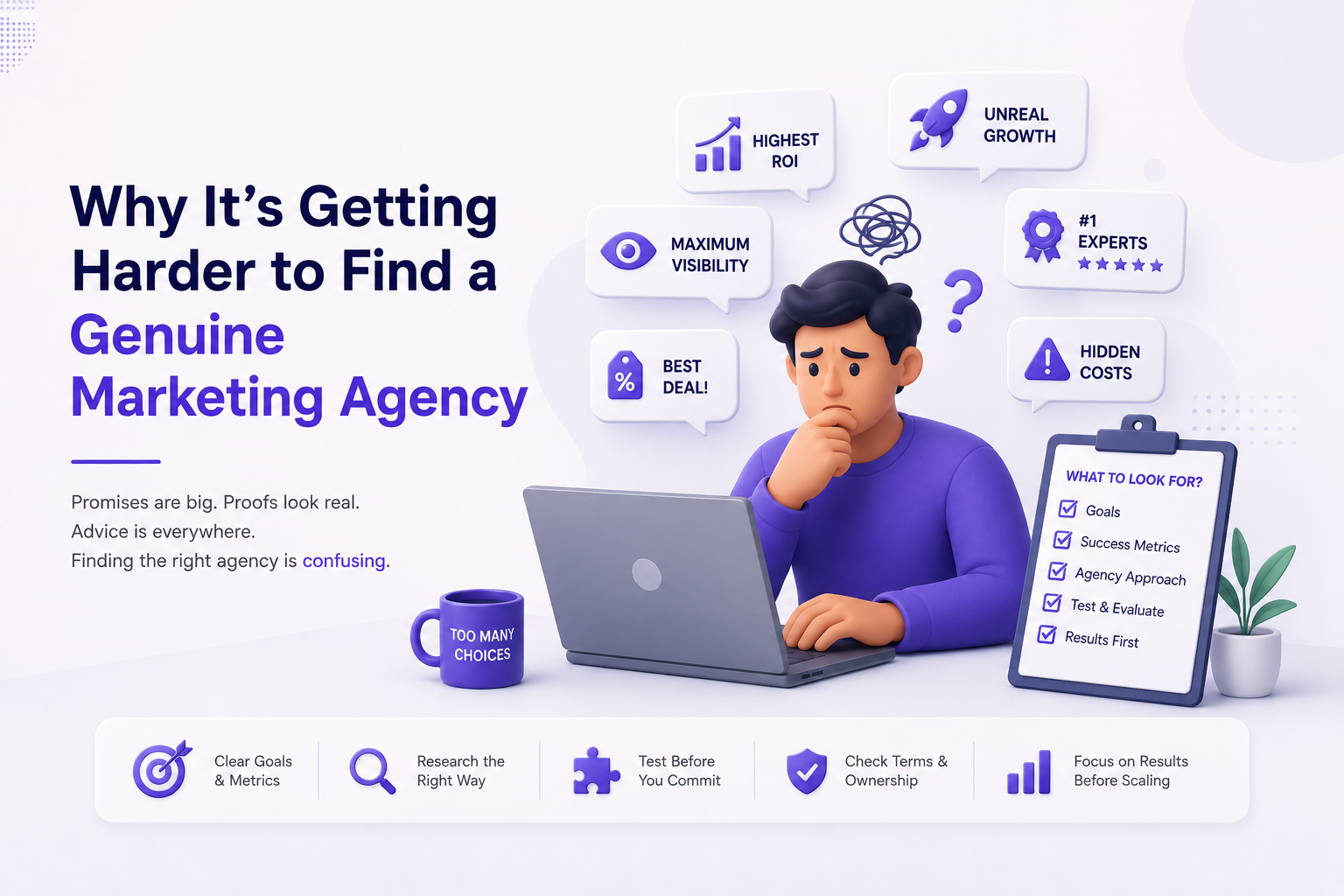
It gets harder and harder the more you dive into screening marketing agencies and shortlisting them.
We all know why. Everyone’s experienced. Everyone’s an expert. Everyone says almost the same thing in different ways. They promise big, show all the proof, offer great deals. And you’re left confused about who’s actually right and who to pick.
Today let’s dive deeper into why this happens and how to navigate through it.
The Practical Problem
There are some simple reasons behind the confusion. Having broad goals. Not knowing where to find agencies. Not knowing what to look at when evaluating them, how to shortlist, or how to make a deal or partnership work. You can find plenty of answers to these on the internet, just google it or ask a chatbot for a clear step by step process. I’m linking a Reddit AI response here that I found genuinely helpful. But if you’re someone who doesn’t like AI generated action plans, here are the same points written by me, a human:
- Be clear on what you want (your goals)
- Know how you can measure the results (success metrics)
- Find a genuine agency through their case studies and their approach (the ones that are keen to know more about you, not the ones suggesting solutions right at the beginning)
- Test with a sample project, and be cautious of hidden costs, terms and conditions and assets ownership.
- Focus on results before scaling the contract
The Deeper Problem
If you still couldn’t figure out the right agency for you, let me address the doubts an overthinker would have at this point, because most of you are probably one by now.
These are more like beliefs than doubts:
- Bold promises and statements from agencies that contradict something you fundamentally believe
- You don’t fully believe online data, AI, or the internet world. You’re the kind of person who thinks the real world and the internet world are two different things
- Marketing becoming formulaic, less room for creativity and innovation, which feels like it’s taking your real identity and essence away
- Marketing feels wrong, or at least the approach today’s marketing industry has taken feels fundamentally wrong
- You feel like you’re becoming part of a rat race
- Doubting whether marketing even works, because it just seems like it’s working, not that it actually is
- Overloaded with a lot of this kind of information, and yeah, my perspective here might confuse you even more too. Just kidding.
| Problem | Problem explanation | Solution / What to do |
| 1. Bold statements | Agencies make bold promises like highest ROI, maximum visibility, unreal profits. The concern is whether these outcomes are actually possible, sustainable, and within the agency’s control. On top of that, repeated claims like “No SEO, No Revenue” or “No Branding, No Customers” make businesses distrust agencies and marketing as a whole. | Don’t judge marketing by the promise alone. Ask how the agency intends to achieve the result, what variables affect it, what the risks or side effects are, and what they’re sacrificing to achieve that growth. Also understand that fake promotion exists in every industry, but that doesn’t make the entire industry fraudulent. Look for an agency that can explain marketing realistically rather than selling certainty. |
| 2. Online world vs. offline world | You feel that internet data is filtered, biased, or disconnected from what happens in the real world. You may wonder whether online opinions, searches, reviews and customer behaviour actually represent reality. | Accept that all data has some bias, including real-world responses. What matters is how the agency handles that uncertainty. Ask what research methods they use, how they validate information, how they interpret data, and whether they test their assumptions. Good marketing isn’t about finding perfectly accurate data; it’s about continuously testing and improving decisions despite imperfect data. |
| 3. Marketing becoming formulaic | Marketing feels repetitive. Agencies follow the same processes, copy ideas from competitors or the internet, and rely on established formulas. This can make brands lose their individuality and creativity. | Don’t reject formulas completely—they exist for a reason. Instead, look for the thinking that happens on top of the formula. Ask about the agency’s creative process, how they approach problems, how they generate ideas, what they do to encourage innovation, and whether their work demonstrates originality. |
| 4. Marketing feels wrong | Marketing can feel manipulative when the focus shifts from helping customers to increasing ROI, hitting metrics, and pushing short-term promotions. Lack of transparency can make businesses feel that marketing is becoming more about tricking people than creating value. | Look beyond what the agency promises and understand what they believe marketing is supposed to do. Examine their existing client relationships: How long have clients stayed? What happened after the initial growth? Did results remain sustainable? Ask about their philosophy and approach to marketing rather than only asking about metrics and deliverables. Very few agencies are driven by a genuine core marketing idea. Guess who’s one of them? |
| 5. You feel like you’re becoming part of the rat race | Everyone seems to be competing through the same channels—SEO, social media, paid advertising and other increasingly crowded strategies. Businesses end up competing with thousands of others for the same limited attention, making marketing feel like a never-ending race. | Find an agency that starts with your business problem rather than a predefined marketing strategy. Pay attention to whether they ask about your customers, behaviour, competitors, goals and expectations before recommending tactics. Then ask how their strategy will actually differentiate you from competitors who are doing the same things. |
| 6. Does marketing even work? | Marketing can feel unnecessary when you believe a genuinely good product or service should sell itself. If marketing isn’t directly producing sales, it can seem like an additional expense and workload. | Think of marketing as part of the customer experience, not simply promotion. Good marketing helps customers discover, understand, evaluate and choose your product or service. Use both inbound and outbound opportunities where appropriate—but remain disciplined about the budget. Marketing should create value, not become a financial burden. |
| 7. Overloaded with information | There are too many experts, opinions, strategies and recommendations. Because agencies are good at marketing themselves, the differences between them can appear very small. Search engines and AI can make this worse by giving you endless information that sounds useful but may not actually apply to your situation. | Start by defining what you actually need from an agency. Ignore attributes that don’t matter to your business and focus on the few qualities that do. When using AI or search engines, clearly state your goals and intent instead of accepting the first generic answer. Most importantly, distinguish between an idea being good and an idea being right for your business. |
