






 SIMPL - School
Information Management Portal
SIMPL - School
Information Management Portal WINGS - Placement portal
 eNABLE - HR solution
 ALMA DRIVE - Alumni Portal

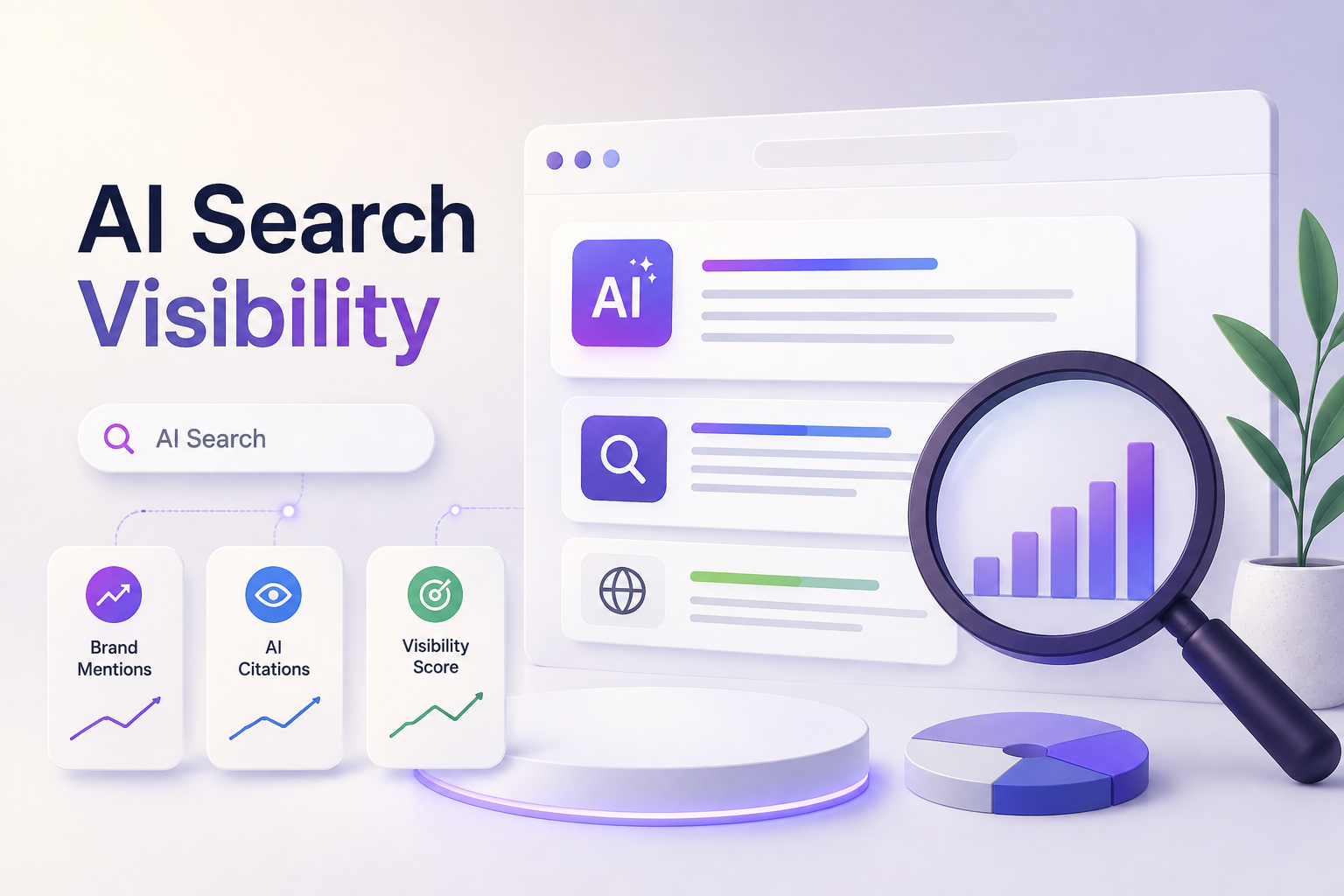
How to Track and Measure Your Brand’s AI Search Visibility
AI search visibility is the one metric most brands still aren’t tracking — and it’s already deciding whether customers find you or your competitor first.
Search has quietly split into two systems. There’s still Google, and now there’s an entire layer of AI answer engines sitting on top of it: ChatGPT Search, Perplexity AI, Microsoft Copilot, Google AI Mode, and Claude AI.
Your AI brand visibility across these platforms doesn’t show up in Search Console. It doesn’t show up in your regular rank tracker either.
This guide walks through exactly how to measure, track, and report on AI search visibility — with the metrics, tools, and process that actually hold up in 2026.
Table of Contents
What Is AI Search Visibility?
AI search visibility is the measure of how consistently your brand appears, gets cited, and gets recommended across AI answer engines like ChatGPT, Perplexity, Google AI Overviews, and Copilot when users ask questions related to your products or industry.
It covers four things: whether you show up at all, how you’re described, whether your page gets cited as a source, and whether the AI recommends you over competitors.
Think of it as your share of voice inside AI-generated answers — the modern equivalent of a page-one Google ranking.
AI Brand Visibility vs. Traditional Google Rankings
Ranking #1 on Google used to be the finish line. Not anymore.
| Traditional Google Rankings | AI Search Visibility | |
| What “winning” means | Ranking #1 in the organic results | Getting named inside the AI-generated answer |
| Where the answer lives | On the results page — the user still has to click through | Directly inside the response, so the click becomes optional |
| Driving force | Classic algorithmic ranking | Search Generative Experience (SGE) and its successor, Google AI Mode |
| Click behavior | A click was the outcome you optimized for | Most AI Overview sessions produce zero clicks at all |
| What’s at stake if you’re missing | You lose a possible click | You lose the customer’s entire consideration set |
That’s why brand visibility in AI search isn’t a nice-to-have anymore. If the AI names three competitors and skips you, you’re not just missing a click — you’re missing the sale before the buyer ever opens a browser tab.
The AI Search Ecosystem You’re Now Competing In
Five years ago, “search” meant Google. Today, the AI search ecosystem includes at least five platforms your customers already use daily.
ChatGPT Search handles direct, real-time queries, and OpenAI’s own numbers put weekly usage well past 900 million people. A meaningful share of those conversations are people researching products or asking for recommendations — the exact intent that used to live entirely inside Google.
Perplexity AI built its whole product around cited, source-backed answers, and visitors arriving from it reportedly convert far better than average organic traffic. Microsoft Copilot sits inside Windows, Edge, and Microsoft 365, reaching enterprise buyers where they already work. Claude AI is increasingly the pick for research-heavy, high-consideration questions.
Each platform pulls from different sources and weighs them differently. A brand that dominates one can be nearly invisible in another.
Why AI Search Analytics Are Different From Google Analytics
Improving brand visibility in AI search starts with understanding what these platforms can actually see — and Google Analytics simply wasn’t built for that.
Google Analytics was built to measure clicks. AI search analytics has to measure something that often never produces one at all.
When ChatGPT or Perplexity answers a question using your content, that’s a real impression — but GA4 has no field for it. This is where AI referral traffic comes in. When an AI platform does send someone to your site, that visit usually shows up as unlabeled direct or referral traffic unless you’re tagging URLs and watching for AI-specific referrers.
The bigger structural issue is AI indexing. AI answer engines don’t crawl and rank pages the way Google does — they retrieve, synthesize, and cite in real time, so being indexed by Google guarantees nothing about whether you get pulled into an answer.
Some people call this whole discipline LLM optimization, since you’re shaping what large language models retrieve and repeat, not just what a search engine indexes.
The AI Visibility Metrics That Actually Matter
You can’t manage what you don’t measure. Here’s how to measure AI visibility in a way that gives you something to act on, not just a vanity number.
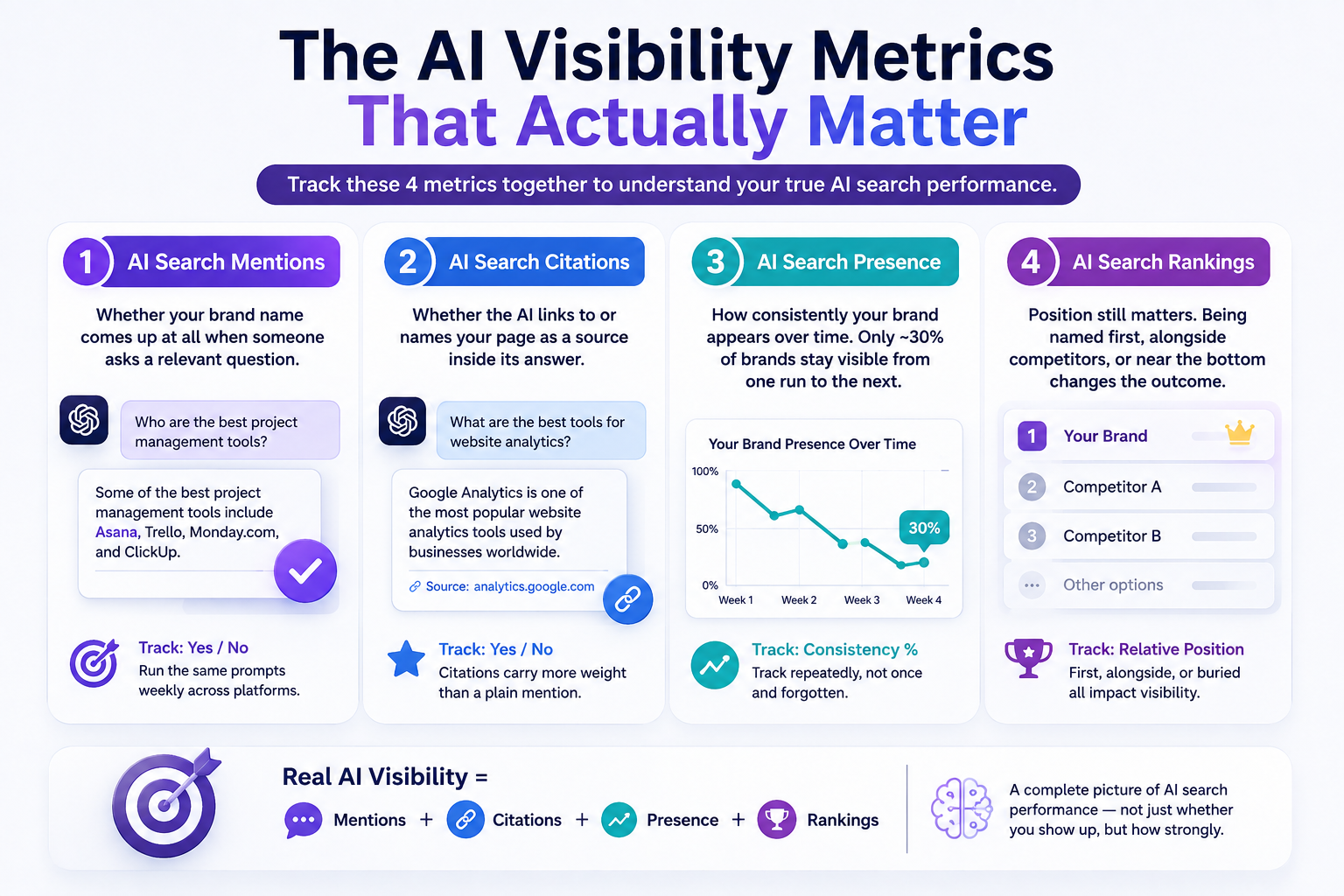
There are four AI visibility metrics worth tracking every month, side by side:
AI Search Mentions
This is simply whether your brand name comes up at all when someone asks a relevant question — your most basic AI search mentions signal. Run the same set of prompts weekly and log a yes or no for each platform.
AI Search Citations
Citations are different from mentions — this is whether the AI links to or names your page as a source inside its answer. AI search citations carry more weight than a plain mention, since they signal the platform trusts your content enough to attribute it.
AI Search Presence
Presence looks at consistency over time. As the earlier AirOps data showed, only around 30% of brands stay visible from one run to the next, so AI search presence has to be tracked repeatedly, not checked once and forgotten.
AI Search Rankings
There’s no numbered rank inside a ChatGPT answer, but position still matters. Being named first, listed alongside two competitors, or buried near the bottom of a longer answer all count as very different AI search rankings outcomes.
Track these four AI visibility metrics together, and you get a real picture of AI search performance — not just whether you show up, but how strongly.
How to Track AI Search Visibility: A Step-by-Step Process
Here’s the process we run for clients who need real AI search tracking, not guesswork:
- Build a prompt list. Write 20–30 real questions your buyers ask — category questions, comparison questions, “best X for Y” questions.
- Run each prompt across platforms. Test the same prompts on ChatGPT Search, Perplexity AI, Google AI Mode, and Microsoft Copilot.
- Log four data points. Mentioned yes/no, position in the answer, competitors named, and sources cited.
- Repeat weekly. AI answers shift with every model and index update, so a one-time check is close to useless.
- Compare against competitors. Your AI search tracking only means something next to who else is getting named in the same answers.
- Tag and watch AI referral traffic. Add UTM parameters where you can, and check GA4 for AI-platform referrers.
This is the same discipline as rank tracking. It’s just pointed at a different results page.
Tools for AI Search Monitoring and Citation Tracking
Manual prompt-testing works, but it doesn’t scale past a handful of keywords. This is where dedicated AI search monitoring tools come in.
The category is new, but it’s moving fast — some platforms now process hundreds of millions of prompts a month across ChatGPT, Perplexity, Gemini, and Google AI Overviews.
| Tool | Best For | Free/Paid | Tracks |
| Manual prompt tracking (spreadsheet) | Getting started with zero budget | Free | Mentions and citations you log by hand, prompt by prompt |
| Otterly.AI | Agencies and lean SEO teams wanting affordable, self-serve monitoring | Paid, from $29/mo (free trial only, no permanent free tier) | ChatGPT, AI Overviews, Perplexity, Copilot; AI Mode, Gemini, and Claude as paid add-ons |
| Ahrefs Brand Radar | Teams already on Ahrefs who want AI data bundled with existing SEO tools | Free basic tier, paid add-ons from ~$398/mo for full coverage | AI Overviews, AI Mode, ChatGPT, Perplexity, Copilot, Gemini share of voice |
| Semrush AI Visibility Toolkit | Teams wanting AI visibility and traditional SEO in one dashboard | Paid, bundled into Semrush plans (a free checker tool is also available) | Prompt-level visibility, share of voice, sentiment, citation tracking |
| Peec AI | Mid-market brands and agencies needing sentiment and competitor benchmarking | Paid, from ~$95/mo, no free plan | Citation source URLs, brand sentiment/framing, competitor comparison |
| Profound | Enterprise brands and large agencies running formal AEO programs | Paid, from $99/mo (realistically $399+/mo), custom Enterprise tier | Multi-platform citations, prompt volume, competitor share of voice |
AI Search Optimization: Best Practices to Improve Your Visibility
Tracking tells you where you stand. AI search optimization is how you actually move the number.
Here’s what consistently works, based on what these platforms actually cite:
Strengthen E-E-A-T signals. Experience, Expertise, Authoritativeness, and Trust aren’t just a Google ranking concept anymore — AI-generated answers pull more confidently from sources that show real credentials, author bios, and original data.
Add structured data everywhere it fits. Schema markup — Organization, Product, FAQ, and Article schema — gives AI systems a clean, machine-readable way to understand your entity SEO and pull accurate facts about your brand.
Build out your entity in the Knowledge Graph. The more consistently your brand’s name, description, and facts appear across the web, the easier entity recognition becomes for AI systems, and the more confidently they’ll mention you correctly.
Write for questions, not just keywords. This is the core idea behind Answer Engine Optimization (AEO) and Generative Engine Optimization (GEO): structure content around direct, extractable answers instead of long, thin-spread pages built for semantic search alone.
Earn real citations, not just backlinks. AI answer engines weigh third-party mentions — reviews, comparison articles, forum threads — often more heavily than your own homepage copy. That’s how AI recommendations get built over time.
Publish content AI can actually extract. Short, direct answers near the top of the page, clear headers, and comparison tables all improve AI content discovery and AI content visibility.
Do this consistently, and you start showing up in more AI-generated answers, earning more AI brand mentions, and building the kind of brand authority that AI answer engines treat as a trustworthy source.
That’s really the whole game: measure AI visibility honestly, then optimize toward the gaps.
Conclusion
AI search visibility is quickly becoming the real battleground for brand discovery — often more decisive than a Google ranking. Skip AI search tracking for a month, and you’re flying blind.
Start small: run the same prompts across ChatGPT Search, Perplexity AI, Google AI Mode, and Microsoft Copilot every week. Track your AI search mentions and AI search citations side by side.
Then layer on AI search optimization — sharper E-E-A-T signals, clean structured data, content built for AI answer engines — and your AI brand visibility compounds month over month.
The brands that measure AI visibility today, before it’s standard practice, are the ones who’ll own AI search rankings tomorrow.
FAQs
1. How do I measure my brand’s AI search visibility?
Start with a fixed list of 20–30 real customer questions. Here’s how to measure AI search visibility without expensive tools: run those prompts across ChatGPT, Perplexity, and Google AI Mode every week, and log whether you’re mentioned, cited, and how you compare to competitors.
2. Can I see when ChatGPT mentions my brand?
There’s no native dashboard for this yet. Here’s how to track brand mentions in ChatGPT: run a fixed prompt set weekly and log the results yourself, or use a dedicated monitoring tool once you’re tracking more than a few keywords.
3. How often should I check my AI search performance?
Weekly is ideal, since answers shift with every model update. Here’s how to monitor AI search performance without it eating your whole week: automate the prompt runs and only review the data manually once a month.
4. Is there a way to know if ChatGPT mentions my website?
Here’s how to know if ChatGPT mentions my website: ask it the exact questions your buyers would ask, then check whether it names your domain or cites your page as a source in the response.
5. What tools should I use to track this?
Here are the best tools to track AI search visibility right now: Semrush One, Profound, Otterly, and Peec AI, alongside a manual spreadsheet if you’re just getting started.
6. What’s the fastest way to improve my brand’s presence in AI answers?
Here’s how to improve AI brand visibility fastest: earn citations on third-party sites these platforms already trust — reviews, comparisons, and forum threads — rather than relying only on your own homepage.
7. How do you count a mention accurately?
Here’s how to measure AI brand mentions accurately: distinguish a plain mention from a citation with a link, and log both separately, since they signal very different levels of platform trust.
8. Does Google AI Mode work differently from AI Overviews?
Google AI Mode visibility tracking works differently from classic rank tracking, since AI Mode pulls from a much wider pool of pages than the traditional top 10 organic results.
9. Is tracking my ChatGPT rankings the same as normal SEO tracking?
ChatGPT SEO tracking isn’t the same as tracking traditional rankings — there’s no keyword position to check, only whether and how your brand gets named inside a generated answer.
10. How do I compare visibility across multiple AI platforms at once?
To measure brand presence across AI search engines, run the identical prompt set on each platform and score them side by side — one platform’s result alone tells you almost nothing.
