







 SIMPL - School
Information Management Portal
SIMPL - School
Information Management Portal WINGS - Placement portal
 eNABLE - HR solution
 ALMA DRIVE - Alumni Portal

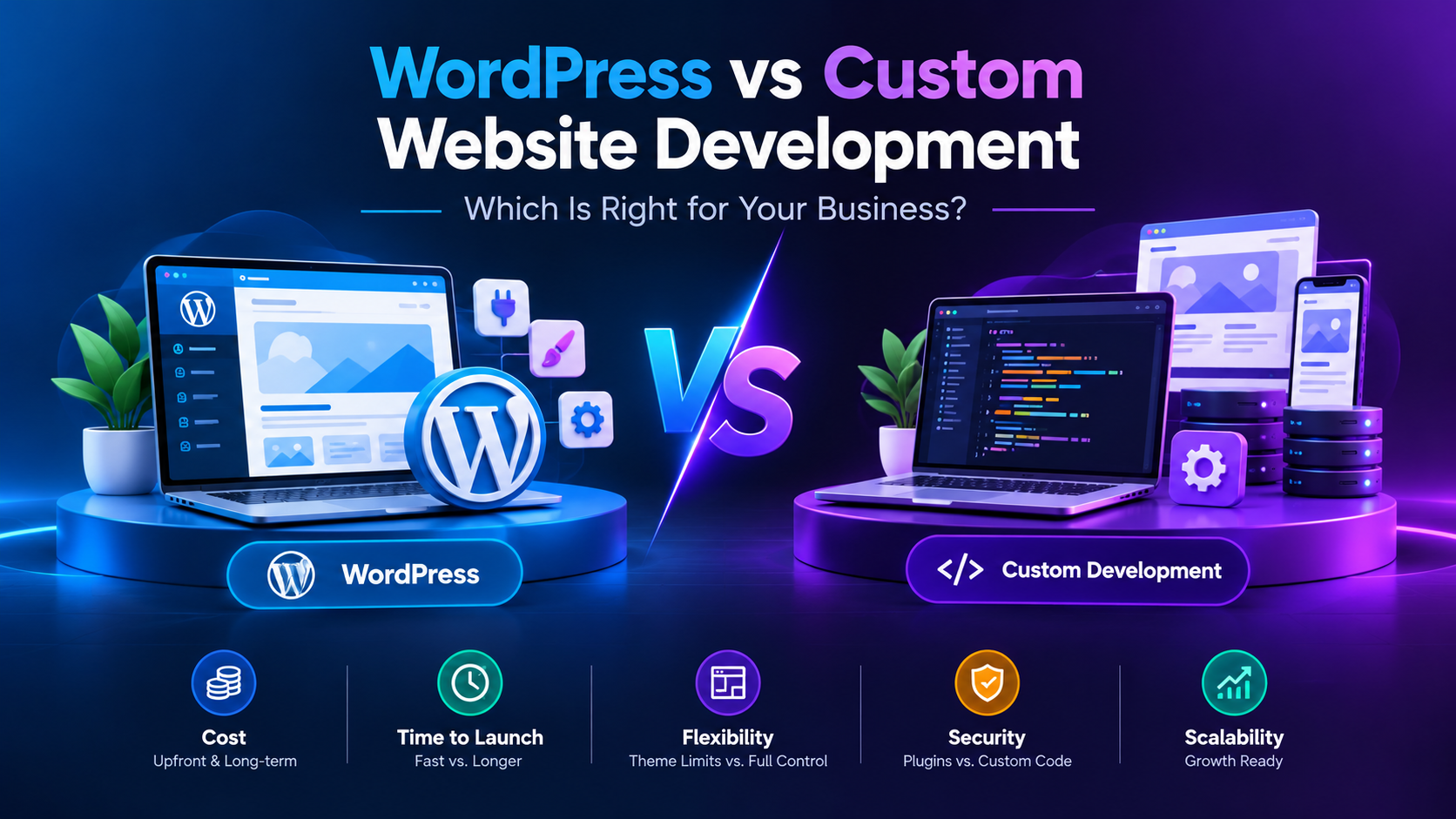
WordPress vs custom website development is the first big decision most business owners face before building a new site. There is no one-size-fits-all answer, and anyone who promises one is probably selling something.
At Swaragh Technologies, we have been building websites in Bangalore since 2006. We have seen both routes succeed, and we have seen both go wrong.
So here is a straight comparison of WordPress vs custom web development, written for business owners, not developers.
Table of Contents
What Is WordPress Website Development?
WordPress is a content management system (CMS). You get a ready-made foundation, then shape it with themes and plugins.
With WordPress theme customization, a developer adapts a theme’s layout, fonts and colors to your brand. After launch, your team edits pages without calling a developer every time.
Where WordPress Works Well
- Faster launch: weeks, not months
- Lower website development cost: the core is free and good themes are affordable
- Easy editing: your marketing team stays in control of content
- Plugin ecosystem: forms, bookings, SEO and payments are mostly a plugin away
- Easy to hire for: plenty of developers know it, so you’re never locked in
Where WordPress Struggles
- Plugin overload slows pages and causes conflicts
- Website security depends on how diligently updates are applied. Patchstack’s yearly reports consistently show most WordPress vulnerabilities sit in plugins and themes, not core
- Website design flexibility shrinks once you push against a theme’s structure
- Complex logic, like custom pricing engines or multi-role portals, gets hacky fast
What Is a Custom-Built Website?
A custom-built website is designed and coded from scratch around your business. No template. No borrowed layout.
Every page, feature and workflow is planned for your users and your processes.
Where a Custom Build Wins
- Total website customization: every screen and workflow is yours
- Better website scalability when traffic or features grow
- Cleaner code and tighter website performance optimization
- Website functionality and integrations that connect cleanly to your ERP, CRM or payment gateway
- Can reduce reliance on third-party plugins, depending on the architecture and required integrations
Where It Hurts
- Higher upfront cost and a longer timeline
- You depend on the team that built it
- Content changes may need a developer unless a proper admin panel was built
- Website maintenance falls entirely on you, with no plugin community to lean on
Custom-Built Website vs WordPress: Where They Really Differ
Custom-built website vs WordPress is not about which one is “better”. It is about which one fits your business.
Here is a side-by-side view:
| Factor | WordPress | Custom-built |
| Website development cost | ₹60,000 to ₹1.5 lakh (typical business site) | ₹3 lakh to ₹15 lakh+ |
| Time to launch | 3 to 6 weeks | 3 to 6 months |
| Website design flexibility | Good, within theme limits | Highly flexible |
| Website scalability | Fine for most; needs work at high traffic | Built around your growth plan |
| Website maintenance | Regular core, theme and plugin updates | Developer-led fixes and upgrades |
| Website security | Strong core; plugins are the weak spot | Smaller surface; depends on code quality |
| Best for | Blogs, service sites, small stores | Portals, platforms, complex workflows |
Website design flexibility and customization
Say you want a pricing page that changes based on the service a visitor picks. On WordPress, you will probably find a plugin that gets you most of the way there.
WordPress theme customization works well for layouts, colours and sections. But you are building inside a theme’s structure, and that is where the limits show up.
With a custom build, website design flexibility has no ceiling. Every screen is designed around how your customers actually behave.
Website customization can go as deep as a booking flow, a quote calculator or a dealer login.
Website scalability
WordPress handles most business traffic well with good hosting and caching. A service website with a few thousand monthly visitors rarely has trouble.
Trouble starts with huge product catalogues, memberships or heavy database use. That is where website scalability becomes a real concern.
A custom build is planned around your expected load from day one.
Website security
WordPress security depends on keeping the core software, themes and plugins updated, choosing trustworthy extensions, and following good security practices. Custom-built websites also require secure coding, access controls, regular testing and ongoing maintenance.
Custom sites have a smaller public attack surface, but they are not automatically safe. Security still depends on your developer’s coding standards.
Website performance optimization
Speed affects revenue. Google research found that 53% of mobile visits are abandoned when a page takes longer than three seconds to load.
WordPress can be fast, but website performance optimization takes effort: caching, image compression and fewer plugins.
A custom-built website can be optimized around specific performance requirements, while a WordPress website can also achieve strong loading speeds with suitable hosting, caching, optimized themes and carefully selected plugins.
Website maintenance
On WordPress, website maintenance is regular work: core, theme and plugin updates, plus backups and uptime checks.
Maintenance requirements depend on the technology stack, integrations and security needs. Custom websites also require regular updates and testing.
Either way, budget for a maintenance plan. A site left alone slowly breaks.
Website functionality and integrations
Payment gateways, WhatsApp chat, Google Analytics, CRM forms: WordPress has plugins for almost all of it.
The trouble starts when you need to connect older software or run business logic that no plugin offers. Website functionality and integrations get messy fast.
Custom integrations can provide greater control over data flows and business logic when implemented and maintained correctly.
A Middle Path: Hybrid Business Website Solutions
You don’t always have to pick one side. Some of the smartest business website solutions blend both.
- Headless WordPress: WordPress manages content, while a custom front end handles speed and design.
- WordPress with custom plugins: you keep the easy editing and add exactly the feature you’re missing.
Both give you website customization where it matters, without rebuilding everything.
A Quick Checklist Before You Decide
A WordPress vs custom website choice gets easier with a checklist. Answer these honestly:
- List the features you need on day one and in two years.
- Set a realistic budget, including maintenance.
- Decide how often your team will update content.
- Check whether the site must connect with other software.
- Estimate traffic growth over the next 12–24 months.
- Ask who will maintain the site after launch.
If most answers are “simple and soon”, lean towards WordPress. If they are “complex and unique”, lean towards custom.
Conclusion
Neither option wins in every case. WordPress gives you speed and affordability. Custom gives you control and room to grow.
Choose for the business you are today, with a clear plan for tomorrow. WordPress vs custom web development is not a one-time choice, and many businesses start on WordPress and move to a custom build later.
Not sure which way to go? Talk to the Swaragh Technologies team. We will review your requirements and recommend the route that fits.
FAQs
1. Which is better, WordPress or custom website development?
Neither is better for everyone. WordPress suits businesses that need a fast, affordable, easy-to-update website. Custom development suits businesses that need unique features, complex integrations or high-traffic scalability. Match the choice to your budget, timeline and how central the website is to your operations.
2. WordPress vs custom website development for small businesses: which makes more sense?
For most small businesses, WordPress makes more sense. A professional site can go live in 3-6 weeks, your team can edit content without a developer, and the upfront website development cost stays low. Consider a custom build only if you need features plugins cannot deliver, such as a booking engine or dealer portal.
3. How much does custom website development cost?
In India, a custom business website typically costs ₹3,00,000 to ₹6,00,000, while portals and web applications often cost ₹6,00,000 or more. The final price depends on the number of pages, design complexity, integrations and security requirements. Hosting and maintenance are extra.
4. Is WordPress better than a custom-built website?
WordPress is better when speed, budget and easy updates matter most. A custom-built website is better when you need complete design control, unique functionality or tight integrations with other software. Content-led business sites usually do well on WordPress, while platforms and portals fit custom better.
5. When should a business choose custom website development?
A business should choose custom development when its website is part of core operations or when plugins cannot do the job cleanly. Typical triggers include:
- Customer portals or dealer logins
- Booking, quoting or pricing engines
- Marketplaces with complex workflows
- Integrations with CRM, ERP or inventory software
- High traffic, or strict security and compliance needs
6. WordPress vs custom website development cost: which is cheaper in the long run?
WordPress is cheaper upfront, but the gap can narrow over three to five years. Premium plugins, workarounds and security fixes add recurring costs. Custom development costs more at the start but can reduce rework when requirements are complex. For simple sites, WordPress usually stays cheaper.
7. Which website platform is best for a growing business?
The best platform is the one that supports your next two years of growth. If your needs are standard, start with WordPress. If you expect complex features, heavy traffic or deep integrations, plan a custom build. A hybrid, such as WordPress with custom plugins, suits many scaling companies.
8. Should I choose WordPress or a custom-built website for my business?
Answer three questions: which features you need now, what budget you have, and how quickly you expect to grow. A simple feature set, a tight budget and a quick launch point to WordPress. Complex features, unique workflows and big growth plans point to a custom-built website.
