






 SIMPL - School
Information Management Portal
SIMPL - School
Information Management Portal WINGS - Placement portal
 eNABLE - HR solution
 ALMA DRIVE - Alumni Portal

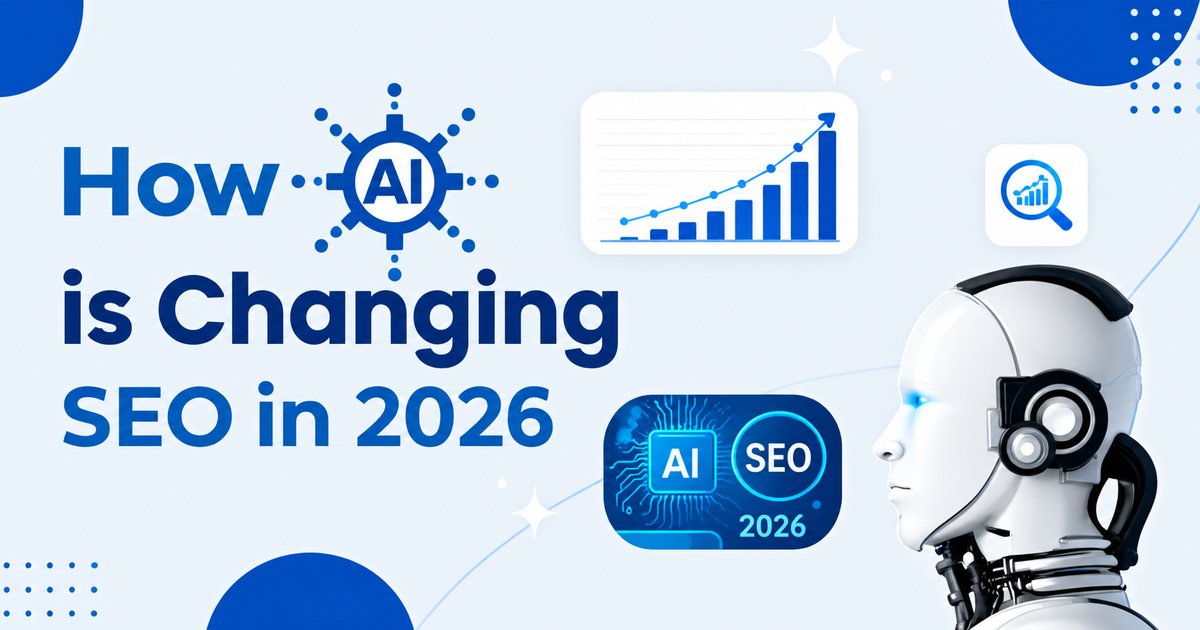
How AI Search Is Changing SEO in 2026
AI Search SEO is the practice of optimizing content for AI-powered search engines like Google AI Overviews, ChatGPT, and Gemini. In 2026, search engines are using large language models (LLMs) to generate direct answers — that means your content must be structured, authoritative, and conversational. Strategies like Answer Engine Optimization (AEO) and Generative Engine Optimization (GEO) are now essential to every modern SEO plan.
And here’s the truth — if your SEO approach is similar to that of 2022, then you are already behind. AI-powered search engines are no more trends. They are the new normal.
This guide explains exactly what’s happening, why it matters, and what you can actually do about it.
Table of Contents
What Is AI Search SEO?
AI Search SEO is the practice of optimizing content to appear in AI-generated search results — not just blue links, but the summaries, overviews, and direct answers that AI engines produce. In 2026, this means being chosen as a trusted source by Google AI Overview, ChatGPT Search, and Perplexity — not just ranking for keywords.
Traditional SEO focused on ranking for keywords. AI Search SEO focuses on being chosen as a trusted source by AI models like Google’s Gemini, ChatGPT Search, and Perplexity.
How Search Has Changed in 2026
Over 58% of Google search results now feature some form of AI-generated content at the top. That number has only grown.
In 2025, Google processed over 14 billion searches per day — and a growing share of those now return AI-generated answers before a single blue link appears.
Here’s what’s driving this shift:
- Google AI Overview now appears for millions of queries daily — including commercial, informational, and local searches
- Search Generative Experience has moved from an opt-in lab experiment to the default search experience globally
- Zero-click searches have surpassed 65% on mobile devices — users get their answer and leave
- Conversational search SEO is exploding as users ask full questions in natural language instead of fragmented keywords
- Google AI Mode, launched in 2025, allows users to have multi-turn conversations directly inside search
- Multimodal search is rising — users are searching with images, voice, and text together, and AI understands it altogether.
AEO in SEO
What Is Answer Engine Optimization (AEO)?
AEO in SEO stands for Answer Engine Optimization — structuring your content so AI answer engines like ChatGPT, Perplexity, and Google can extract and serve it as a direct answer. The goal isn’t just ranking. It’s being cited by the AI.
The goal isn’t just ranking. It’s being cited by the AI.
In 2026, AEO is no longer optional. Perplexity alone crossed 100 million monthly active users in late 2024 — and its entire model is built around pulling answers from trusted sources. If your content is not optimized in terms of AEO, there will be no chance of showing up.
Here’s what AEO focuses on:
- Writing clear, question-and-answer formatted content that AI can lift and use directly
- Using structured data and schema markup — FAQ, HowTo, Article, and Speakable schemas
- Answering the exact question in the first 1–2 sentences — before any preamble
- Building topical authority across a full subject cluster, not just individual pages
- Optimizing for voice search — over 50% of AEO queries in 2026 are spoken, not typed
GEO in SEO
What Is Generative Engine Optimization (GEO)?
GEO in SEO stands for Generative Engine Optimization — optimizing your content so AI models like ChatGPT, Gemini, and Perplexity reference your site when generating answers. Unlike AEO, which wins the answer box, GEO wins the citation inside AI-generated responses.
In 2026, a new layer has been added to GEO: AI agents. Tools like ChatGPT Operator, Google’s Project Astra, and Perplexity’s Comet are now autonomously browsing the web, making decisions, and recommending products and services — without any human typing a query. If your brand isn’t optimized to be discovered by AI agents, you’re missing an entirely new channel of organic visibility.
What actually gets you cited in AI responses?
A Princeton/Georgia Tech study found pages cited up to 40% more often when they had:
- Real statistics with sources attached — vague claims get skipped
- Direct quotes from credible experts — AI models favour attributed opinions
- Authoritative language — clear, confident claims, not hedged suggestions
- Structured formatting — headers, bullets, and defined terms AI can parse fast
- Original research or data — something AI genuinely cannot find replicated elsewhere
- Freshness signals — content updated in the last 90 days is prioritised over older pages in fast-moving topics
How Google AI Overview Is Reshaping Rankings
Google AI Overview reads multiple pages, selects the most trusted content, and writes its own answer — appearing above all organic results including ads. Your page can rank #1 and still be skipped if the AI finds your content unclear or outdated. Getting cited requires structured content, strong E-E-A-T signals, and schema markup.
What Google AI Overview has changed about search in 2026:
- Position 1 is no longer the top of the page — Google AI Overview sits above everything, including ads
- Your meta description doesn’t matter here — the AI rewrites your content in its own words
- One wrong claim can disqualify your entire page — AI models avoid sources with outdated or contradictory information
- Getting cited in AI Overview ≠ getting a click — but it does build brand trust at massive scale
- Smaller, niche sites are getting cited over big brands — because their content is more specific and direct
- AI Overview now includes shopping results — product pages optimized with structured data are being pulled directly into AI-generated purchase recommendations
- Multi-step queries are the new normal — users ask follow-up questions inside the same search session, and Google’s AI maintains context across all of them
The Difference Between SEO, AEO, and GEO
SEO gets your content found in the search index. AEO gets your content selected as a direct answer in AI answer engines. GEO gets your content cited inside AI-generated responses on ChatGPT, Gemini, and Perplexity. These are not competing strategies — they are three layers of the same modern SEO game in 2026.
| Traditional SEO | AEO | GEO | |
| What It Does | Gets you found in the search index | Gets you chosen as the direct answer | Gets you cited inside AI-generated content |
| Where You Show Up | Blue link results on Page 1 | Answer boxes and featured snippets | Inside ChatGPT, Gemini, Perplexity responses |
| Who You’re Optimizing For | Google’s crawling algorithm | AI answer engines | Generative AI language models |
| The Win | User clicks your link | User sees your answer without clicking | AI quotes your content as its source |
| Biggest Risk if You Ignore It | No organic traffic | Competitors own your question real estate | Your brand is invisible in AI conversations |
| Content That Works Best | Long-form keyword-optimized articles | Short, direct Q&A formatted content | Data-rich, expert-backed, deeply researched content |
| How Trust Is Built | Backlinks and domain authority | Schema markup and direct answers | Brand mentions, citations, and original research |
| What Kills Your Chances | Slow site, weak backlinks, thin content | Vague answers, no schema, buried information | Outdated facts, no data, generic writing |
How to Optimize for AI Search Engines: 8 Proven Strategies
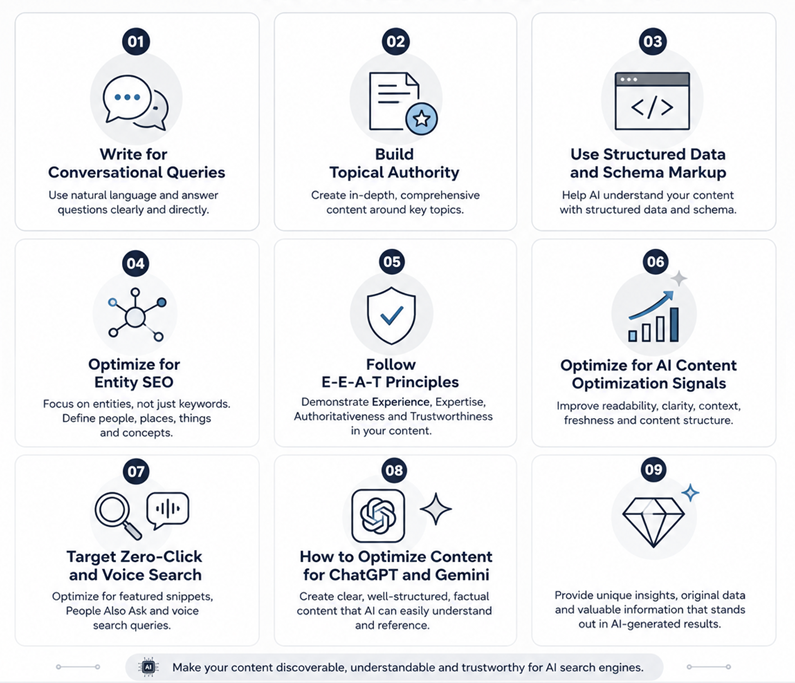
1. Write for Conversational Queries
Most AI-powered search engines process natural language processing inputs — full questions, not fragmented keywords.
In 2026, the average search query is now 23 words long on voice and 11 words long on text — up from 3–4 words just five years ago. Users aren’t searching, they’re talking.
Optimize your content by:
- Including question-based headers (H2/H3) that mirror how real people ask questions
- Answering questions in the first 2–3 sentences — before any context or backstory
- Using natural, conversational tone throughout — write like you explain, not like you keyword-stuff
- Anticipating follow-up questions and answering them in the same piece
2. Build Topical Authority
AI models don’t just look at one page — they evaluate your entire site on a subject.
In 2026, Google’s systems can detect topical gaps in your content cluster. If a competitor covers a subject more completely than you, their entire domain gets a trust boost — not just individual pages.
- Create content clusters around one core topic — a pillar page supported by 10–15 subtopic articles
- Link related articles together with descriptive anchor text
- Cover subtopics thoroughly before expanding to new subject areas
- Refresh older content regularly — AI systems favour recent, updated material
3. Use Structured Data and Schema Markup
If you want to appear in AI-generated answers, structured data is non-negotiable.
In 2026, Google has expanded its schema support — and AI crawlers from Perplexity, Bing Copilot, and ChatGPT Search all use structured data signals to decide which content to trust and extract.
These schema types should be used:
- FAQ Schema — for Q&A content; directly feeds AI answer engines
- HowTo Schema — for step-by-step guides; pulled into voice and AI results
- Article Schema — for blog posts with author, date, and publisher signals
- Speakable Schema — for voice search optimization; marks which sections are read-aloud friendly
- Product Schema — for e-commerce; now appearing directly inside Google AI Overview shopping results
4. Optimize for Entity SEO
Search engines in 2026 are built around entities, such as individuals, locations, brands and ideas, rather than keywords alone.
Google’s knowledge graph already holds more than 500 billion bits of information about the associations between entities. Unless your brand is an entity in Google’s knowledge graph, it will effectively disappear from view as far as the machine-learning aspect of searches goes.
- Define your brand clearly on your site — what you do, who you serve, where you operate
- Link to and from authoritative sources — Wikipedia, industry directories, government sites
- Use your brand name consistently across your site, social profiles, and external mentions
- Build your knowledge graph presence through structured data and consistent NAP (Name, Address, Phone) signals
5. Follow E-E-A-T Principles
Google’s E-E-A-T (Experience, Expertise, Authoritativeness, and Trustworthiness) framework has been turbocharged in 2026.
With AI-generated content flooding the web, Google and other AI engines are aggressively filtering for real human expertise.
- Mention qualifications of the writer, including credentials, years of experience, and more
- Provide data from studies and credible sources — and cite the source as well
- Ensure that content is up-to-date; outdated data lowers your E-E-A-T rating
- Display trust indicators like positive reviews, certifications, citations, and more
- Use first-person statements where appropriate — “We tested,” “in our experience,” etc.
6. Optimize for AI Content Optimization Signals
AI content optimization in 2026 isn’t just about keywords — it’s about how your content reads to a language model.
AI systems parse your content differently from human readers. They look for:
- Clear sentence structures — subject, verb, object. No ambiguity.
- Defined terms — if you use jargon, explain it immediately after
- Bullet points and numbered lists — AI extracts these more reliably than dense paragraphs
- Short paragraphs — under 3 lines; long blocks of text are harder for AI to chunk and cite
- Explicit conclusions — state your point, don’t leave AI to infer it
7. Target Zero-Click and Voice Search
Zero-click searches are queries where the answer appears directly in the result — no click needed. In 2026, this isn’t just a featured snippet phenomenon — it’s the default behavior across Google AI Overview, Siri, Alexa, and Gemini Live.
To capture these:
- Write concise answers of 40–60 words for common questions — this is the sweet spot for AI extraction
- Optimize for voice search optimization — target question phrases like “how to,” “what is,” “best way to,” and “should I”
- Use conversational queries as your H2/H3 headers — the exact phrasing people speak, not just what they type
- Structure your page so the answer appears before the explanation — inverted pyramid style
8. How to Optimize Content for ChatGPT and Gemini
ChatGPT Search (powered by Bing) and Gemini (powered by Google’s index) have different crawling behaviours, but the same fundamental trust signals:
- Be a topical authority — cover your subject completely, not just one angle
- Use semantic search signals — related terms, synonyms, co-occurring entities
- Get mentioned on authoritative external sites — Wikipedia, industry publications, news outlets
- Structure content with clear headers so AI can extract specific sections without reading the whole page
- Add original data or perspectives — AI models actively deprioritise content that just restates what’s already widely available
- Publish consistently — both platforms favour brands with a regular publishing cadence over one-off posts
Will AI Replace Traditional SEO?
AI will not replace traditional SEO — but it is making low-effort SEO completely irrelevant. In 2026, quality content, technical health, backlinks, and user experience still matter. What’s changed is that AI has raised the bar on all of them simultaneously. Keyword stuffing is dead. Real SEO built on topical authority and E-E-A-T is stronger than ever.
What AI is replacing:
- Thin, keyword-stuffed content that ranked purely through volume
- Pages built for crawlers, not for real human readers
- Exact-match keyword strategies with no semantic depth or topical context
- Content farms and programmatic pages with no original insight
What’s more important than ever:
- Real expertise and first-hand experience — not just well-written summaries
- Strong search intent optimization — matching content to what the user actually wants, not just what they typed
- Fast, technically sound websites — Core Web Vitals are now an AI crawlability signal too
- Genuine brand authority — brands that people search for by name are rewarded across all AI systems
SEO changed. Has your strategy?
Conclusion
AI Search SEO isn’t something you prepare for later — it’s what’s deciding your visibility right now. Google AI Overview, ChatGPT Search, and Perplexity are already choosing which brands get cited and which ones get skipped entirely.
The future of SEO belongs to brands that build real topical authority, demonstrate genuine E-E-A-T, and structure their content for both human readers and AI crawlers.
Traditional SEO isn’t dead — but standing still is. The gap between brands optimizing for AI-first search and those still running 2022 playbooks is widening every month.
Start with one thing: make your content so clear, so trustworthy, and so complete that an AI model has no reason to look anywhere else. That’s the foundation of every generative AI SEO strategy that works in 2026 and beyond.
FAQ’s
1. How is AI search changing SEO in 2026?
Ranking on Page 1 used to be the finish line — in 2026, it’s just the starting point. Google AI Overview, ChatGPT Search, and Perplexity now generate direct answers by pulling from multiple trusted sources. Your content needs to be cited inside those answers, not just ranked below them.
2. What is AEO and GEO in SEO — and why do both matter?
AEO gets your content selected as the direct answer. GEO gets your content quoted inside AI-generated responses on ChatGPT and Gemini. AEO wins you the answer box. GEO wins you the citation. In 2026, you need both — because users are searching on Google and asking AI assistants at the same time.
3. What is the difference between SEO, AEO, and GEO?
Three layers:
- SEO — you show up in blue links
- AEO — you become the direct answer
- GEO — you become the source AI quotes
Ignore any one of them and you’re handing visibility to your competitors
4. How do you optimize for AI search engines in 2026?
Six things that actually move the needle:
- Get your brand cited on trusted external sites
- Write a direct answer in your first 100 words
- Use FAQ, HowTo, and Article schema markup
- Build topical authority — cover your subject completely
- Add real statistics and original data
- Keep every fact accurate and updated
5. How do you optimize content for ChatGPT and Gemini specifically?
Be the most thorough source on your topic — cover the full picture
- Use real data with source attribution
- Get mentioned on Wikipedia and industry publications
- Structure content with clear headers so AI can extract sections easily
- Cut the fluff — every paragraph should answer or prove something
6. Will AI replace traditional SEO — or do both still matter?
AI won’t kill SEO — it’s killing lazy SEO. Keyword stuffing and thin content are already ineffective. Technical SEO, genuine expertise, and strong backlinks still work — and now feed into AI ranking factors too. Low-effort SEO is dead. Real SEO isn’t.
7. What are the best AEO strategies for 2026 that actually work?
- Lead with the answer — state it before explaining it
- Write H2s as actual questions people ask
- Add FAQ schema to signal answers to AI
- Build question clusters — answer 10–15 related questions per page
- Update content regularly — AI deprioritizes outdated answers fast
8. How do you rank in AI answer engines and get cited consistently?
Three things most brands overlook:
- Semantic completeness — cover the topic so thoroughly that AI doesn’t need to look elsewhere
- Original data — AI prefers citing unique sources, not recycled information
- Brand consistency — your expertise should match across your site and external mentions
