







 SIMPL - School
Information Management Portal
SIMPL - School
Information Management Portal WINGS - Placement portal
 eNABLE - HR solution
 ALMA DRIVE - Alumni Portal

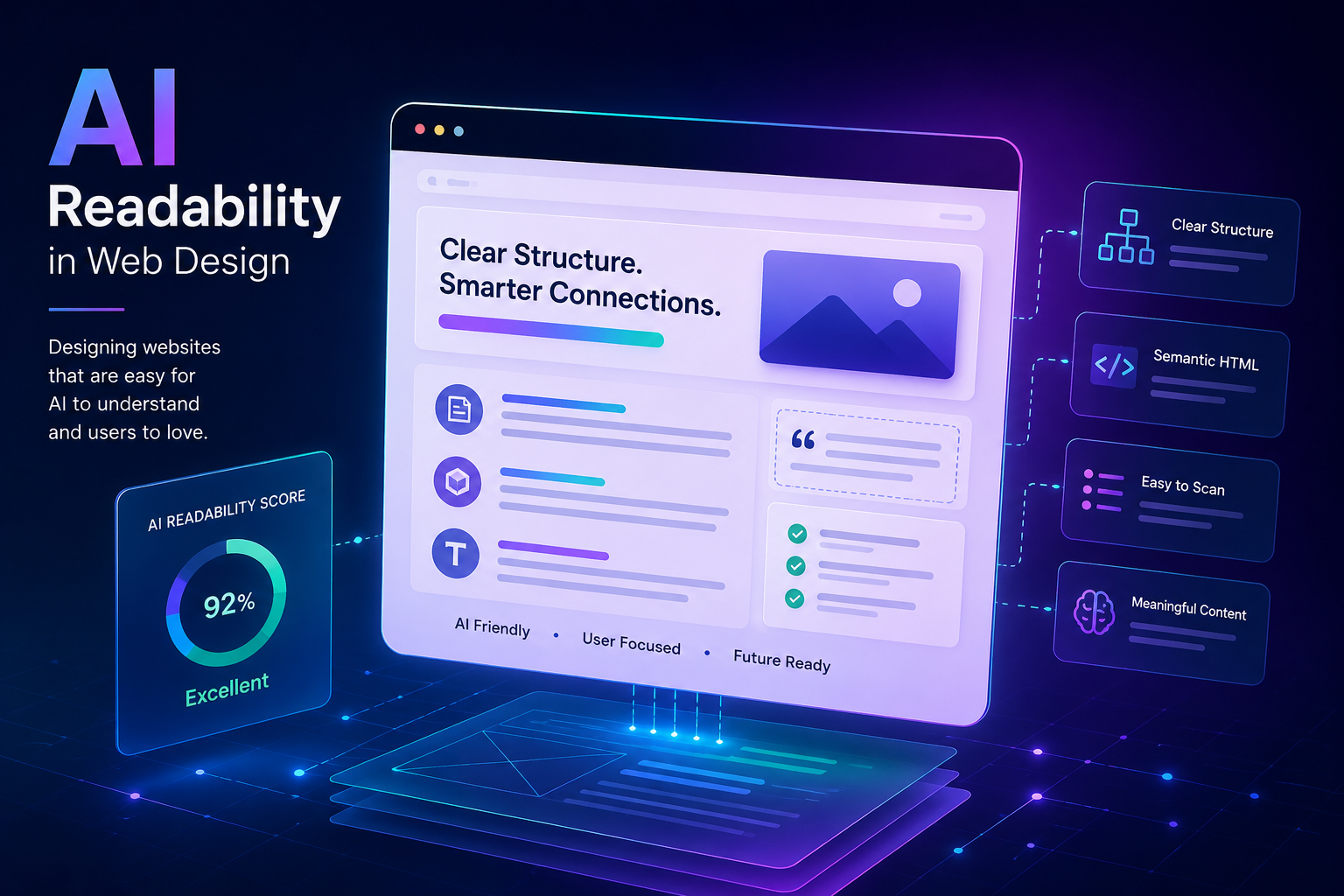
AI Readability in Web Design: How to Build Websites Humans Love and AI Can Read
AI readability in web design is no longer optional. It’s the deciding factor between a website that shows up in ChatGPT answers and one that AI models skip entirely.
Search is changing fast. Google AI Mode, AI Overviews, and answer engines like Perplexity now pull information directly into their responses, often without a single click to your site.
That means your website structure for AI Overviews matters as much as how it looks to a human visitor. A gorgeous homepage means nothing if an AI crawler can’t parse your content. This guide walks you through exactly how to build a website that both people and machines can read, trust, and cite.
Table of Contents
What Does AI Readability in Web Design Actually Mean
AI readability in web design is the practice of structuring your site so AI crawlers, language models, and answer engines can extract, understand, and reuse your content accurately.
Human readability is about layout, tone, and flow. AI readability is about the code, hierarchy, and machine-parseable structure sitting underneath that layout.
Think of it as writing two experiences at once. One for the person scrolling on their phone. One for the bot indexing every heading tag, JSON block, and internal link on the page.
The short answer for making your website readable by AI is: build for structure first, decoration second. And when it comes to designing for both users and AI, the two goals overlap more than you’d think — clean structure serves both audiences at once.
Why Does Website Structure Matter for AI Search Engines
AI search engines don’t browse a page the way we do. They rely on heading hierarchy H1 H2 H3, clean HTML, and clear content hierarchy to figure out what matters.
When your website structure for AI Overviews is messy, AI models either misread your content or ignore it completely. That’s a real cost, since more searches are ending in zero-click search design results.
A well-organized page signals authority. It tells crawlers exactly where the answer lives, which improves your odds of AI Overviews visibility and entity SEO recognition.
How Do You Structure Content for AI Overviews
Getting AI readable content structure right starts with answering the reader’s question in the first two sentences of every section. AI models favor direct, extractable answers.
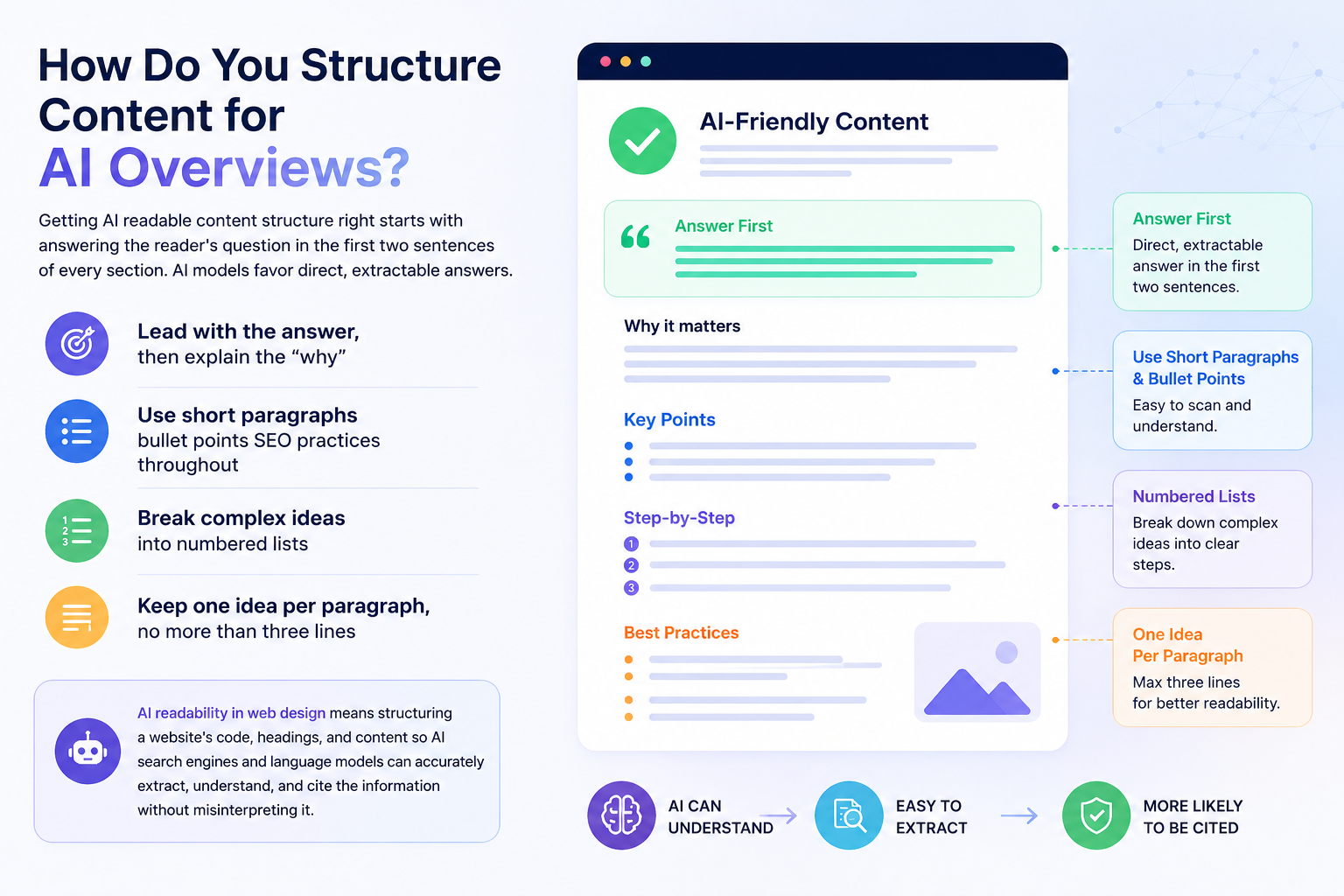
Here’s how to structure content for AI Overviews and featured snippets:
- Lead with the answer, then explain the “why”
- Use short paragraphs bullet points SEO practices throughout
- Break complex ideas into numbered lists
- Keep one idea per paragraph, no more than three lines
AI readability in web design means structuring a website’s code, headings, and content so AI search engines and language models can accurately extract, understand, and cite the information without misinterpreting it.
That paragraph above is intentionally snippet-ready. Short, direct, keyword-first, answer complete in one breath. The result is a scannable content layout that improves user experience (UX) and user interface (UI) at the same time.
Why Is Semantic HTML the Backbone of Machine-Readable Design
Semantic HTML for SEO isn’t a nice-to-have anymore, it’s foundational. Tags like <article>, <nav>, <header>, and <section> tell crawlers what each part of your page actually is.
Without semantic HTML5 tags, an AI crawler sees a wall of <div> soup. It has to guess where your navigation ends and your actual content begins.
This is exactly what machine-readable website design solves. Clean code for crawlers means less guessing, more accurate extraction, and a better chance your content gets used in an AI-generated answer. This is one of the most overlooked pieces of AI readability in web design.
How Does Schema Markup Help You Get Cited by AI Search Engines
Schema markup for AI search is one of the fastest wins in this whole playbook. It’s a translation layer between your content and the machines reading it.
Structured data for AI visibility works through JSON-LD schema, the format Google recommends. It labels your prices, reviews, FAQs, and breadcrumbs in a language bots understand instantly. This is what structured data for AI visibility looks like in production, not theory.
How to add schema markup for AI search, in practice:
- Add FAQ schema markup to any page with Q&A content
- Use BreadcrumbList schema so crawlers understand site hierarchy
- Mark up Article schema for blog content
- Validate everything with Google’s Rich Results Test
Yes, schema markup helps with AI Overviews. Structured content is far more likely to be lifted directly into an AI-generated summary. Get this right and you’ve covered a major pillar of AI readability in web design.
Do You Need an llms.txt File for Your Website
The llms.txt file is a proposed convention that sits at your root domain and gives AI systems a plain-language map of your site. You’ll see it on sites like Anthropic, Cloudflare, and Stripe.
Here’s what it won’t do: help you rank in Google. Google’s official AI optimization guide, published in May 2026, directly lists llms.txt among tactics site owners don’t need — it states plainly that Google Search doesn’t use these files for AI Overviews or AI Mode, and maintaining one won’t help or hurt your visibility there.
Where it may still matter is outside Google Search: agent frameworks, coding tools like Cursor and Windsurf, and RAG pipelines do read it, and Anthropic’s own guidance for building AI agents recommends it. So the honest answer is — skip it if your only goal is AI Overview or ChatGPT citations, but consider it if you’re building for developer tools or AI agents interacting with your site directly.
Why Does JavaScript Navigation Hurt AI Crawlers
Many AI bots don’t execute JavaScript before reading a page — that’s the core problem
JavaScript navigation SEO issues are one of the most common problems we find in website audits. If your main menu or internal links only render after a script runs, crawlers may never see them.
The fix is simple: use real, crawlable href attributes in your HTML. Keep your crawlable website architecture readable even with JavaScript switched off.
How Can You Optimize Your Website for AI Crawlers
AI crawlers website optimization goes beyond code. It touches speed, accessibility, and how easily a bot can move through your entire site. That’s the full picture of AI crawlers website optimization done right.
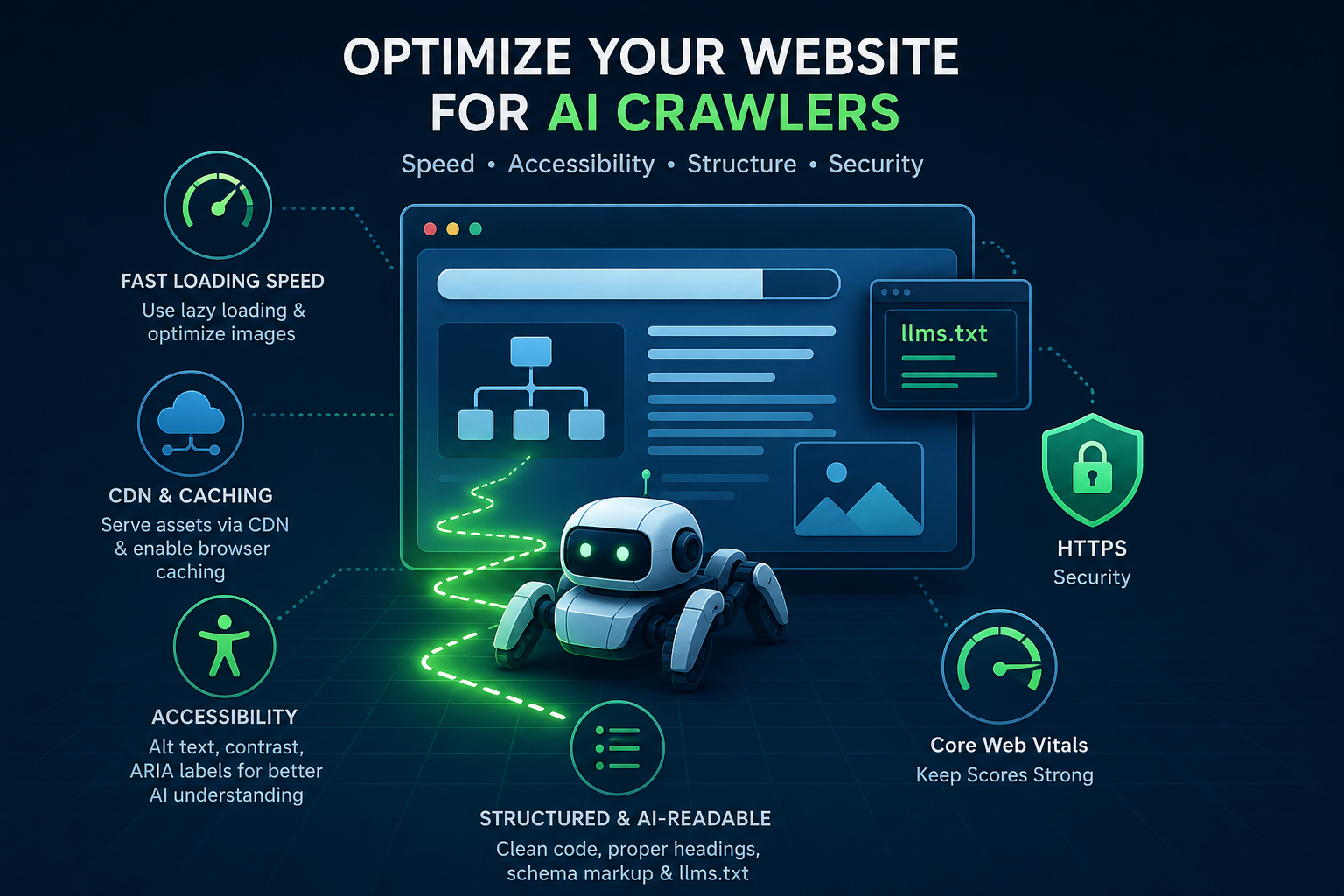
A few essentials:
- Keep website loading speed fast with lazy loading and image optimization
- Serve assets through a CDN and use browser caching
- Protect the whole site with HTTPS security
- Maintain strong Core Web Vitals scores
Accessibility and AI readability go hand in hand here too. Alt text, proper contrast, and ARIA labels help both screen readers and AI crawlers understand your page.
This overlaps heavily with website performance work and landing page optimization you may already be doing for conversions. Get your metadata optimization and search engine optimization basics right first, then layer AI-specific fixes like schema and llms.txt on top. The result is better website usability for everyone, human or bot. Speed and accessibility are just as much a part of AI readability in web design as your code structure.
How Do You Get Cited by ChatGPT and Perplexity
Getting cited by ChatGPT and Perplexity comes down to structure, trust, and consistency. Both tools favor sources with clear formatting, strong E-E-A-T signals, and facts that hold up across the site.
Publish original data. Add author bios. Link to credible sources. These build the trust signals AI models look for before quoting a brand by name.
Consistency matters too. The same facts, stated the same way across your site, make it easier for AI discoverability to lock onto your content as a reliable answer.
What Website Design Mistakes Hurt Your AI Visibility
Some of the most common website design mistakes that hurt AI visibility are surprisingly basic:
- Missing or duplicate meta descriptions
- No FAQ schema markup on question-heavy pages
- Broken internal linking between related pages
- Thin content that never fully answers the query
- Poor mobile-first design that breaks on smaller screens
Each of these chips away at crawlability and indexability, two things AI search engines depend on to trust your site.
How Do You Future-Proof Your Website Design for AI Search
How to future-proof website design for AI search comes down to treating AI readability in web design as a permanent investment, not a one-time fix.
Start with the best heading structure for AI search engines: one H1 per page, logical H2s that read like questions, and H3s that break down specifics underneath.
Pair that with responsive layouts, an accessible web design foundation, and a knowledge graph-friendly approach to naming entities consistently across your site. Good information architecture and a clear website hierarchy make every future AI model’s job easier, not just today’s.
What Should Be on Your Website Checklist for AI Search Visibility
A checklist alone won’t get you there without ongoing machine-readable website design decisions behind it. Here’s a website checklist for AI search visibility 2026:
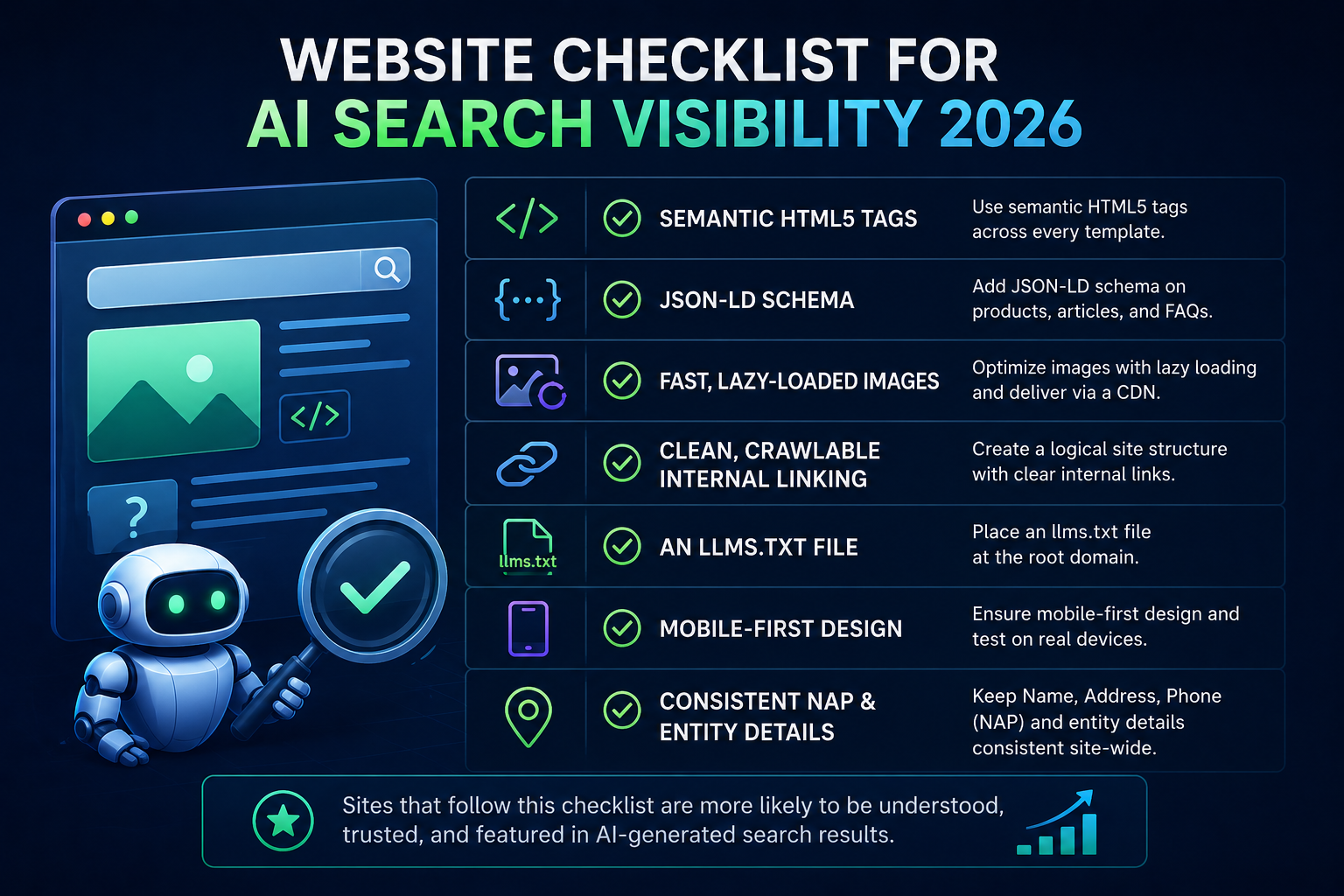
- Semantic HTML5 tags across every template
- JSON-LD schema on products, articles, and FAQs
- Fast, lazy-loaded images with a CDN in front
- Clean, crawlable internal linking
- An llms.txt file at the root domain
- Mobile-first design tested on real devices
- Consistent NAP and entity details site-wide
How web design affects AI Overviews ranking isn’t a mystery anymore. Sites that check these boxes get pulled into AI answers more often, plain and simple.
Conclusion
AI readability in web design isn’t a trend you can skip and catch up on later. The websites winning citations in ChatGPT, Perplexity, and Google AI Mode today are the ones that treated structure, schema, and clean code as priorities months ago.
Start with your heading hierarchy. Add schema markup for AI search. Fix your JavaScript navigation SEO issues, tighten up semantic HTML for SEO, and keep testing. Every choice you make about AI readable content structure compounds over time.
AI search engines are still evolving, and the sites built to be read by machines, not just admired by humans, are the ones that will stay visible.
FAQ
Does semantic HTML actually affect SEO rankings?
Semantic HTML doesn’t directly boost rankings, but it removes ambiguity for crawlers trying to identify your navigation, main content, and article sections. Cleaner parsing means more accurate indexing, which supports both traditional rankings and AI Overview eligibility.
How does schema markup help a website get cited by AI?
JSON-LD schema labels content — FAQs, products, breadcrumbs — in a format AI systems can lift directly into a generated answer. Pages with FAQ schema on question-based content are more likely to surface in AI Overviews than unmarked pages covering the same topic.
Why do AI crawlers skip websites with JavaScript navigation?
Many AI bots don’t execute JavaScript the way browsers do, so menus or links that only render after a script runs are effectively invisible to them. Using real, crawlable href attributes in the HTML avoids this gap entirely.
How is designing for AI search different from traditional SEO?
Traditional SEO optimizes for clicks and rankings on a results page. Designing for AI search optimizes for direct citation — your content needs to hold up and answer the query fully even if the reader never visits your site.
What does an llms.txt file do for a website?
An llms.txt file sits at the root domain and gives AI crawlers a plain-language map of your most important pages, similar in spirit to a sitemap. It’s most useful for content-heavy or product-heavy sites where crawlers might otherwise miss key pages.
What website mistakes hurt AI search visibility the most?
Broken internal linking, thin content that doesn’t fully answer the query, and missing FAQ schema on question-heavy pages are the most common. Each one makes it harder for AI crawlers to trust that a page has a complete answer.
