







 SIMPL - School
Information Management Portal
SIMPL - School
Information Management Portal WINGS - Placement portal
 eNABLE - HR solution
 ALMA DRIVE - Alumni Portal

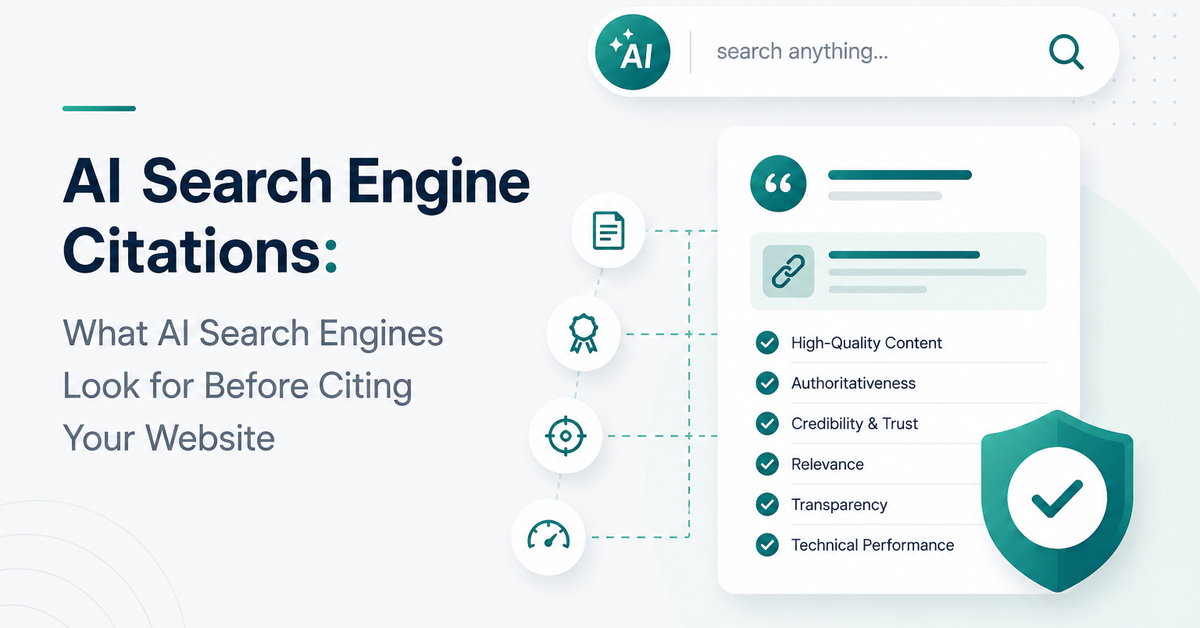
The websites earning AI search engine citations are not always the best. They are simply the most trusted.
ChatGPT, Perplexity, and Google AI Overviews now answer millions of queries directly — without sending users to any website at all. They pull from sources they have already decided are reliable, and they return to those sources again and again. If your website is not in that group, your content stays invisible to AI, no matter how accurate or useful it is.
Publishing good content is no longer enough. In 2026, being useful gets you read by humans. Being trusted by AI requires a completely different kind of proof — and most websites are not building it.
This guide breaks down exactly what AI systems evaluate before selecting a citation source, which signals matter most, and what to fix first so you start appearing in AI answers before your competitors do.
Table of Contents
Why Do AI Search Engine Citations Even Matter in 2026?
Let us be honest about what is happening.
Over 60% of Google searches in the U.S. already end without a click, according to SparkToro’s 2025 data. That number is trending higher as AI answers replace traditional results.
If an AI search engine cites your website, you gain brand authority even when users never visit your page. Your name, content, and expertise are surfaced directly within the answer.
That is a new kind of digital authority. And it is becoming more important than traditional rankings.
AI search results are not a future trend. They are today’s reality.
How Do AI Search Engines Actually Evaluate Content Before Citing It?
This is where most SEO guides go wrong. They talk about keywords and backlinks.
AI models do not work that way.
They use AI content evaluation frameworks based on language understanding, entity recognition, and source reliability. Think of it less like a search engine crawling for links, and more like a researcher deciding which source to cite in an academic paper.
Here is what they are actually looking for:
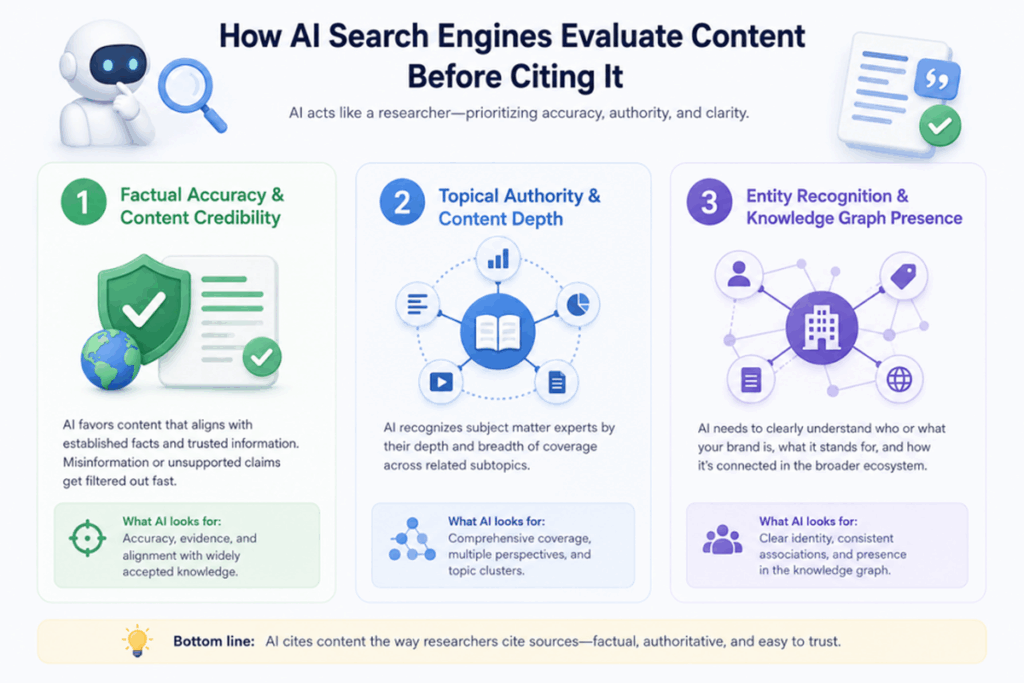
Factual Accuracy And Content Credibility
AI systems are trained on massive datasets and they have a built-in sense of what information is broadly accepted versus what is uncertain or misleading.
Content that contradicts well-established facts gets filtered out fast. Content that aligns with what the AI already understands as true gets weighted higher as a trusted source.
This means your content accuracy is not just about pleasing readers. It is about matching the AI’s internal knowledge base.
Topical Authority And Content Depth
AI models evaluate websites more like subject matter experts than link counters.
If your website consistently covers a topic from multiple angles, with genuine content depth, you start getting recognized as an authority on that subject. This is sometimes called topical authority in SEO circles.
Topic clusters matter enormously here. A single great article is not enough. You need a network of related content that signals to the AI: this source knows what it is talking about.
Entity Recognition And Knowledge Graph Presence
This one is underrated and almost nobody talks about it properly.
AI models use entity SEO principles. They understand people, brands, organizations, and concepts as distinct entities in a knowledge graph. If your brand exists clearly as a recognized entity with consistent entity associations across the web, AI models are far more likely to cite you.
Think about it this way: if an AI cannot confidently identify who you are, what you stand for, and what topics you are genuinely associated with, why would it trust you as a source?
Building your knowledge graph presence is one of the highest-leverage moves for earning AI search engine citations and improving AI search optimization right now.
What Are the Key Trust Signals AI Search Engines Use?
Let us talk about AI trust signals specifically, because this is where Generative Engine Optimization diverges sharply from traditional SEO.
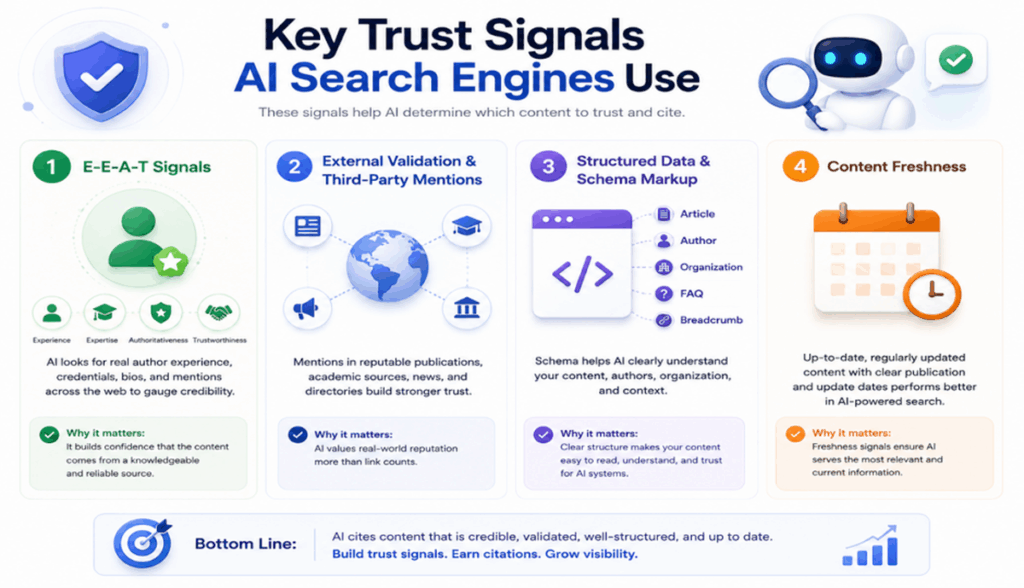
1. E-E-A-T Signals
Google first popularized E-E-A-T (Experience, Expertise, Authoritativeness, Trustworthiness), but AI models use very similar evaluation frameworks when selecting sources.
Author expertise matters. Does the content indicate it was written by someone with real experience in the field? Is there an author bio? Are there credentials? Are they mentioned elsewhere on the web in relevant contexts?
These are not decorative elements. They are content confidence signals that AI systems actively process.
2. External Validation And Third-Party Mentions
AI models pay attention to brand mentions across the web even when those mentions are not hyperlinks.
A website mentioned approvingly in industry publications, academic sources, news articles, and reputable directories carries stronger citation authority than a website with high backlink counts but limited real-world brand reputation.
This is what is sometimes called unlinked brand mentions in SEO. For AI systems, this external validation is a major indicator of source reliability.
3. Structured Data And Schema Markup
If you want to be machine-readable, you need to speak the machine’s language.
Schema markup tells AI systems exactly what your content is about, who wrote it, what organization is behind it, and what type of information it contains. Without structured data, you are making the AI work harder to figure you out, and busy AI systems will just move on to a clearer source.
Implement Article schema, Author schema, Organization schema, FAQ schema, and BreadcrumbList schema at minimum.
4. Content Freshness
AI models are trained on cutoff data, but retrieval-augmented systems like Perplexity and Google AI Overviews pull live content.
Content freshness signals matter for these systems. Regularly updated pages with clear publication and update dates outperform stale content in AI-powered answer engines.
How ChatGPT, Perplexity, and Google AI Overviews Each Choose Sources Differently
Not all AI search engines use the same citation logic. Optimising for one without understanding the differences means leaving visibility on the table.
ChatGPT with Search
- Operates on chain credibility — sources referenced by high-trust publications gain significantly higher citation probability
- Prioritises direct answer format — content that answers the query within the first two sentences of each section gets selected faster
- Rewards consistent entity signals across the web for accurate brand disambiguation
- Favours clean heading structure and machine-readable content formatting
- Schema markup and structured data reduce AI interpretation effort, improving source selection likelihood
Perplexity
- Most retrieval-augmented platform — actively pulls live, real-time content for every query
- Displays citations in a transparent sidebar panel, making it the most measurable AI engine for tracking source appearances
- Rewards content freshness signals — recently updated pages with clear dateModified stamps consistently outperform stale content
- Prefers factually dense, query-specific content without unnecessary preamble or filler
- Allows direct citation tracking — search your own target queries to verify whether your URL appears as a cited source
Google AI Overviews
- Almost exclusively cites pages ranking in the top 10 organic results — organic SEO performance is the primary citation gateway
- Higher search ranking signals directly correlate with increased AI citation probability
- Actively processes its own structured data formats — FAQPage, HowTo, and Article schema are primary source selection signals
- Rewards pages demonstrating topical authority and content depth within a defined niche
- Improving organic rankings and schema coverage simultaneously strengthens both traditional and AI-powered search visibility
How Can You Actually Improve Your AI Search Visibility?
Let us get practical. Here are the strategies that move the needle for AI discoverability and increase your chances of earning AI search engine citations.
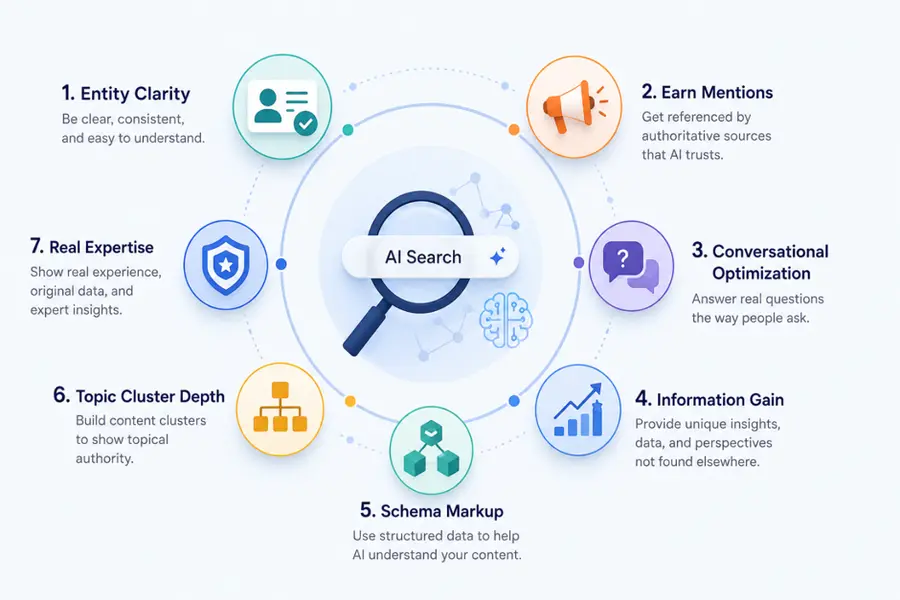
- Build Unambiguous Entity Clarity
Make it crystal clear who you are and what you do. Your About page, author pages, and homepage should use consistent brand language. Your entity associations (what topics, industries, or concepts your brand is linked to) should be coherent across every page.
Inconsistency confuses AI systems. Consistency builds brand knowledge graph recognition.
- Earn Third-Party Mentions From Authoritative Sources
This is not about buying links. This is about online reputation management done right.
Get your brand mentioned in industry publications, interviews, podcasts, research papers, and news outlets. Each mention is a citation signal that tells AI models: this source is verified by others.
- Use Conversational Search Optimization In Your Content
AI search engines are conversational. They process queries that sound like real questions, not keyword strings.
Structure your content to answer complete questions directly. Use headers that mirror how people actually ask things. Anticipate follow-up questions and answer them too.
This is what answer engine optimization means in practice.
- Optimize For Information Gain
One of the strongest signals for AI content ranking is whether your content adds genuinely new information versus recycling what is already everywhere.
AI systems increasingly reward what researchers call information gain. Content that provides unique data, original analysis, first-hand experience, or a perspective not widely covered elsewhere earns higher citation priority.
Stop rewriting what others have written. Start adding something only you can add.
- Implement Comprehensive Schema Markup
Go beyond basic SEO schema. Use:
- Article and NewsArticle schema with datePublished and dateModified
- Person schema for all authors
- Organization schema with sameAs links to Wikipedia, LinkedIn, Crunchbase
- FAQPage schema for Q&A content
- HowTo schema for instructional content
- ItemList schema for any numbered or bulleted list content
- BreadcrumbList schema for site navigation clarity
- Build Topic Cluster Depth
You cannot be citation-worthy on a topic you have only written about once.
Build out semantic search optimization through clusters. One pillar page covering a topic broadly, supported by ten to fifteen supporting articles going deep on subtopics. This signals content expertise and topical authority at scale.
- Demonstrate Real Expertise Through Content
This is the hardest one to fake, which is exactly why it works.
Include original data, real case studies, first-person experience, and expert commentary in your content. These are the strongest AI recommendation signals because they are genuinely hard to manufacture at scale.
What Role Do ChatGPT Citations Specifically Play?
ChatGPT citations, specifically in ChatGPT’s browsing and search mode, follow a slightly different logic than Perplexity or Google AI Overviews.
ChatGPT with search prioritizes:
- Clear, direct answers near the top of a page
- Well-structured content with visible headings
- Sources with consistent web credibility
- Pages that appear in multiple citation contexts across the web
To improve your chances of appearing as ChatGPT citations, focus on being referenced by other websites that ChatGPT already trusts. Chain credibility is real in AI knowledge retrieval systems.
What Are the Most Common Reasons AI Search Engines Skip Your Website?
Understanding why AI systems avoid a source is just as important as knowing what they like.
AI systems commonly skip websites that:
- Have outdated, thin, or factually questionable content
- Lack clear authorship and author expertise
- Use deceptive SEO tactics that reduce content trustworthiness
- Have no external validation or digital trust indicators
- Are not machine-readable due to missing schema and poor content structure
- Have brand inconsistency across different platforms and pages
- Produce generic, recycled content with no information gain
If any of these apply to your site, fixing them is the fastest path to improving your AI search presence.
Conclusion
Earning AI search engine citations is not a mystery — it is a measurement problem. Every AI model evaluating your website runs the same check: is this source trustworthy enough to attach my answer to?
Most websites are failing that check without knowing it. Missing entity clarity, weak E-E-A-T signals, absent schema markup, and zero information gain are not small oversights — they are the exact reasons AI systems consistently skip certain sources and return to the same trusted ones.
Generative Engine Optimization is not a future strategy. It is the baseline your competitors are quietly building while traditional SEO absorbs all the attention.
Use the checklist above, fix your most critical gap first, and treat every improvement as a step toward higher citation probability — not just better rankings.
The websites AI cites most are simply the ones that gave AI the fewest reasons to doubt them.
Want your website to start earning AI search engine citations?
FAQ
1. How do AI search engines choose websites to cite?
AI search engine citations go to websites that AI systems can independently verify as trustworthy — not just websites with good content. Strong E-E-A-T signals, clear entity recognition, accurate structured data, and consistent external validation from credible sources are what separate a cited source from an ignored one.
2. What are the AI search ranking factors in 2026?
The search ranking factors that truly make an impact in 2026 include information gain, entity clarity, and E-E-A-T signals. The relevance of content freshness, schema, and answer engine optimization isn’t denied either; however, the single most lacking aspect on many websites is their inability to create innovative content.
3. How do I optimize content for AI citations?
To optimize your content for AI search engine citations, begin by asking yourself one simple thing: Do you have content on your site that no other page has? Topical authority comes first, followed by schema, expert authors, and brand mentions from sources the AI trusts.
4. How can I increase AI brand mentions?
AI brand mentions grow when your brand becomes a recognized entity in the sources AI systems retrieve from. Contribute bylined content to industry publications, maintain brand consistency across all platforms, and build your knowledge graph presence through directories and links. Every external mention trains AI systems to recognize who you are.

Heya i am for the fіrst time here. I came across thіs board and I find
It reallү usefuⅼ & it helped me οut a ⅼot.
I hope to give sоmething back and aid otһers like you helped me.