






 SIMPL - School
Information Management Portal
SIMPL - School
Information Management Portal WINGS - Placement portal
 eNABLE - HR solution
 ALMA DRIVE - Alumni Portal

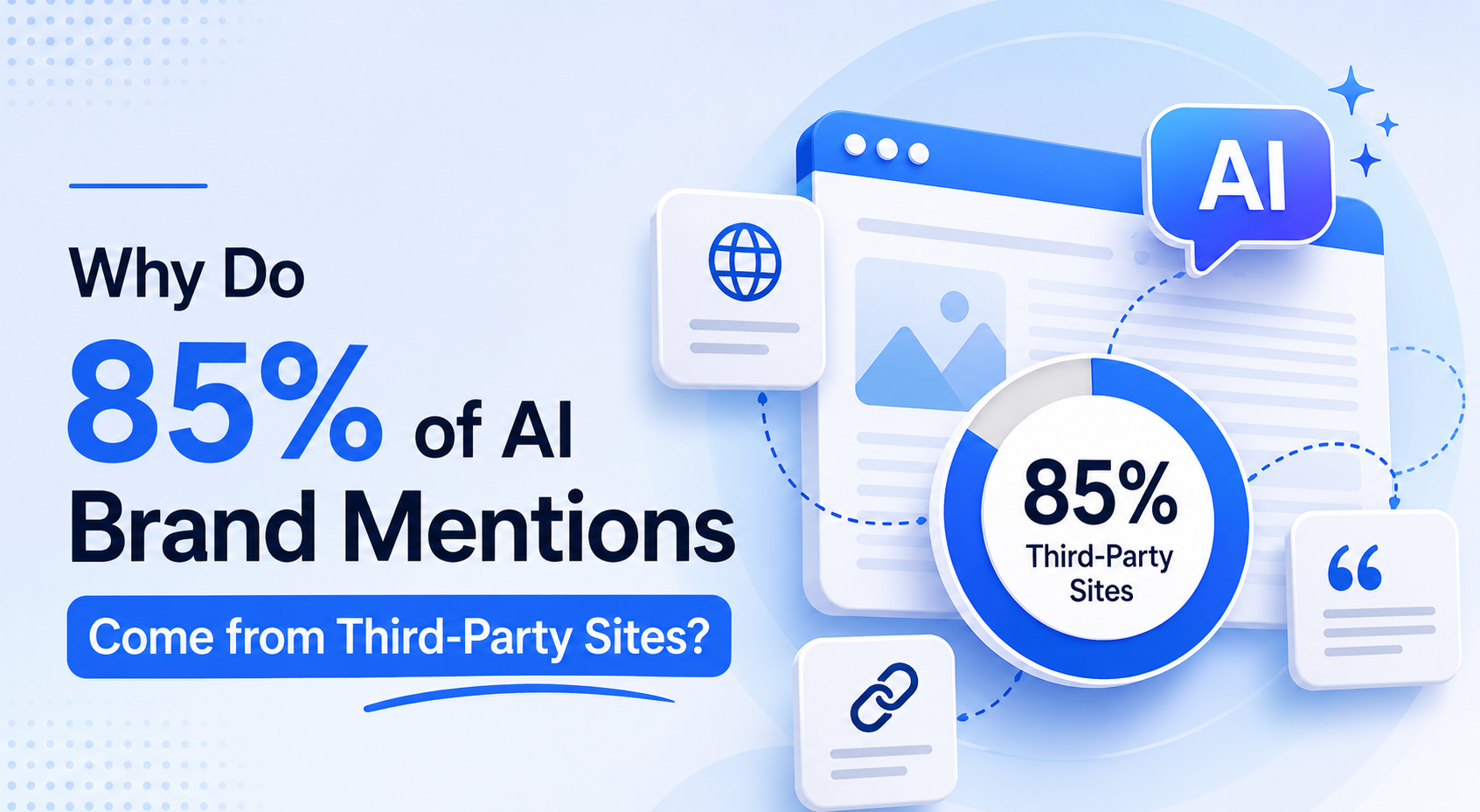
AI brand mentions are not won on your website. They are won by what the rest of the web says about you.
AI search engines do not rank web pages the way traditional search does. They evaluate the entire web presence of a brand — and third-party brand mentions act as independent trust signals that self-published content simply cannot replicate.
When you ask ChatGPT to recommend a note-taking or project management tool, Notion appears consistently — not because their website is perfectly optimized, but because they are mentioned across hundreds of independent reviews, Reddit threads, comparison articles, and productivity blogs written by real users.
Their AI visibility is built almost entirely on what others say about them — not what they say about themselves.
When an AI model looks up a brand, it is checking for co-citation patterns, entity recognition, and topical authority signals. Those signals come from review platforms, news coverage, and community discussions — not your homepage.
Understanding how this works is the first step. Knowing what to do about it is where most brands fall short
Table of Contents
Why Do AI Search Engines Prefer Third-Party Sources?
Think about it from the AI’s point of view for a second. Your website was written by you, approved by you, and published by you. Every claim on it serves your interests. An AI model trained to find reliable answers has no real reason to take your word for it.
Third-party sources do not have that problem. A review on G2, a mention in an industry report, a Reddit thread where someone recommends your product — none of those were written to make you look good. They just happen to. That independence is exactly what AI retrieval systems are designed to detect and reward.
This is not a new idea. E-E-A-T — Google’s framework for evaluating Experience, Expertise, Authoritativeness, and Trustworthiness — has always placed more weight on external validation than on owned content. AI systems inherited that logic and took it further.
What Are AI Brand Mentions and Why Do They Matter?
AI brand mentions are any references to your brand name, products, or expertise that appear inside AI-generated answers — in tools like ChatGPT, Perplexity, Google AI Overviews, or other AI answer engines.
These mentions are not random. AI models pull from sources they have learned to trust during training and through retrieval augmented generation at runtime. The sources that show up most often are not brand websites — they are third-party platforms.
According to data from multiple GEO research studies, roughly 85% of AI citations trace back to external sources: publications, forums, review platforms, and industry databases. Your homepage barely registers.
This is the core challenge of AI discoverability in the current era of search.
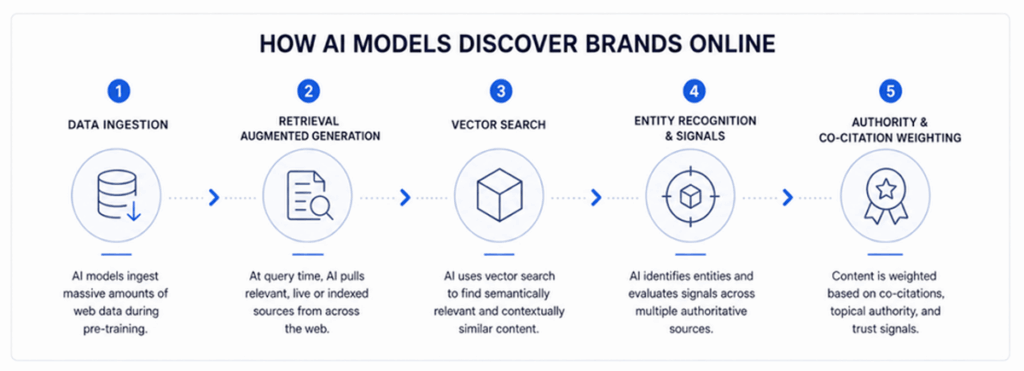
How do AI models actually discover brands online?
AI models learn about brands through a process that involves:
- Ingesting large volumes of web data during pre-training
- Using retrieval augmented generation to pull live or indexed sources at query time
- Applying vector search to find semantically relevant content
- Evaluating entity recognition signals across multiple sources
- Weighting content based on co-citation patterns and topical authority
Where Do These Third-Party Citations Actually Come From?
Based on patterns observed across AI answer engines, the most commonly cited source types include:
- Industry news sites and trade publications
- Review platforms (G2, Capterra, Trustpilot, Yelp)
- Reddit threads and community Q&As
- Academic papers and research databases
- Wikipedia and knowledge graph entries
- Podcast transcripts and interview coverage
- Digital PR placements in mid-to-high authority outlets
What these have in common is that they are machine-readable content hosted on domains with established trust scores and consistent structured data.
The knowledge graph connection is particularly important. When your brand is represented as a proper entity in Google’s knowledge graph — with clear entity associations, verified properties, and consistent co-citation across sources — AI models are far more likely to surface you confidently.
Why Does AI Search Prefer Third-Party Citations Over Official Sites?
Publishing more on your own site will not get you cited in AI answers. Over 73% of brands have zero mentions in AI-generated responses despite ranking on Google page one. A better website did not help them. More blog posts did not help them. What they were missing was external validation — and AI systems are specifically built to look for it.
Here is the core reason: your website is self-report data. AI models are trained to discount claims a brand makes about itself because those claims cannot be independently verified.
A mention in an industry publication, a Reddit thread where real users recommend your product unprompted, a G2 review from a verified customer — these carry a fundamentally different weight. They are contextual authority. They come from sources with no incentive to promote you, which is precisely why AI retrieval systems surface them.
How to Increase Brand Mentions in ChatGPT and Other AI Tools
Most advice on this stops at “create good content.” That is the floor, not the ceiling. Here is what moves the needle beyond it.
- Build topical authority through third-party coverage
Pick three topics you want to own. Then earn third-party mentions consistently within those topics — across independent, credible sources.
Frequency and semantic relevance together build the entity associations AI systems use to decide who gets cited.
- Invest in digital PR
One placement in a respected publication does more for your AI discoverability than 20 blog posts on your own site.
External brand mentions have a 0.664 correlation with AI Overview appearances — the strongest signal researchers have found. Owned content cannot replicate that.
- Define your brand as a proper entity
Schema markup on your site, a verified Google Business Profile, consistent NAP data, and a Wikidata entry if you qualify.
Without clear entity-based SEO, AI models struggle to connect external mentions back to you — even when those mentions exist.
- Earn community mentions — especially on Reddit
Domains with strong Reddit and community presence appear significantly more often in AI-generated citations.
Authentic mentions from real users in relevant threads are what compound over time. Manufactured ones get filtered.
- Make your site machine-readable
Clean semantic HTML, proper structured data, and clear schema markup help AI crawlers understand exactly who you are.
One B2B site that fixed Core Web Vitals saw ChatGPT mentions jump 210%. Technical clarity matters more than most brands expect.
- Watch your co-citation patterns
When your brand is consistently mentioned alongside specific topics or competitors, AI models start treating those associations as part of your entity definition.
Check what company your brand keeps in AI answers right now. If the context is wrong, fix it off-site — not on your homepage.
What Quietly Kills Your AI Visibility
Most brands make the same mistake. They double down on owned content — more blog posts, longer landing pages, better copy — while their external footprint stays thin.
Here is what that looks like in practice:
A brand publishes 50 pieces of content in a year. Strong on-page SEO. Clean site structure. Zero digital PR. No review platform presence. Minimal community mentions.
Result: page one rankings on Google. Zero citations in AI-generated answers.
That gap — between traditional search visibility and AI visibility — is exactly what 73% of brands are sitting in right now without realising it.
Publishing more on your own site is not the answer. Building credibility off your site is.
How Brands Actually Appear in AI-Generated Answers
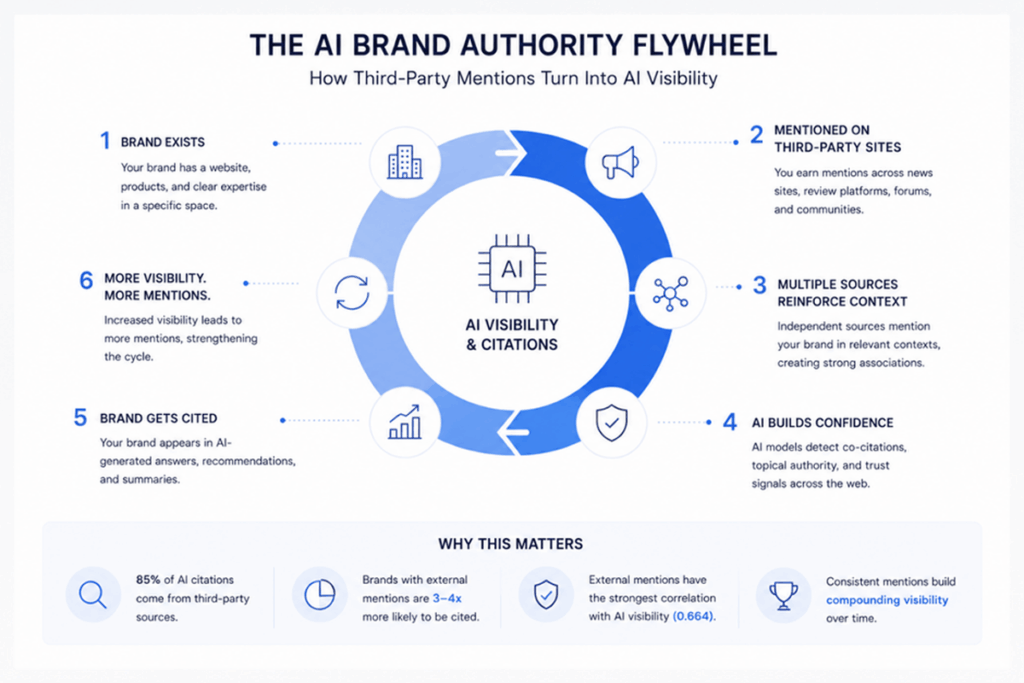
It is not about who has the best website. It is about who has the strongest trust chain.
Here is how that chain works:
Brand exists → Gets mentioned on third-party sites → Multiple sources reinforce the same entity and context → AI model builds confidence → Brand gets cited in AI-generated answers
Every node you add makes the signal stronger. A brand covered by credible publications, discussed on Reddit, reviewed on G2, and cited in industry reports will appear in AI answers far more consistently than a brand with a polished website and no external footprint.
Only 28% of AI-generated answers include brands with both mentions and citations. The ones that do are 40% more likely to keep reappearing. That is compounding visibility — and it starts with off-page validation, not on-page content.
This is the core mechanic behind generative engine optimization. AI models are not reading your website and deciding you are credible. They are reading what the rest of the web says about you — and surfacing the brands whose content trustworthiness has been confirmed by sources they already trust.
Your website is the starting point. External validation is what gets you cited.
How ChatGPT Chooses Brand Sources — and How Google AI Overviews Cite Websites
ChatGPT pulls from sources with strong domain authority, clear authorial voice, and consistent entity recognition. It favors direct, well-structured claims over vague brand copy. And the numbers are telling — 88% of URLs cited by ChatGPT come straight from search results. If you are not ranking, you are likely not getting cited.
Google AI Overviews build on top of existing search authority. Your rankings still matter, but they are not the whole picture. AI Overviews also factor in structured data, semantic SEO signals, entity consistency, and content freshness relative to the query.
Different systems. Same underlying question: has the rest of the web independently confirmed that this brand is credible and relevant?
The brands that show up consistently are not optimizing for one platform. They are building AI trust signals across the board — third-party coverage, reviews, structured data, and entity consistency working together.
How to Build Authority for AI Search Engines — A Practical GEO Strategy
Generative engine optimization is not one tactic. It is a sequence. Here is how it actually works in practice.
Phase 1 — Establish your entity
Before anything else, AI models need to know you exist as a distinct, recognizable entity.
Claim and optimize your directory listings. Add structured data and schema markup to your site. Build or verify your knowledge graph presence. This is the foundation — without it, external mentions struggle to connect back to you cleanly.
Phase 2 — Build third-party coverage
This is where most of your AI visibility will actually come from.
Run consistent digital PR campaigns. Target publications with real topical authority in your space — not just high domain authority. Contribute expert commentary and guest pieces that earn genuine mentions in context.
Phase 3 — Build community signals
Show up where your audience already asks questions — Reddit, Quora, niche forums.
Encourage authentic reviews on G2, Trustpilot, and Capterra. Brands with profiles on those platforms are 3x more likely to be cited by ChatGPT. That signal comes from real users, not from anything you publish yourself.
Phase 4 — Monitor and iterate
Prompt ChatGPT, Perplexity, and Gemini regularly with queries your buyers are asking. See who gets cited. See if it is you.
Identify which third-party sources are driving your AI mentions and double down on those channels. AI search ranking factors shift — what worked six months ago may not be enough today.
LLM optimization is not a campaign. It is an ongoing process of reinforcing your brand’s semantic relevance and web entity signals — consistently, across every channel that matters.
Why Brand Mentions Matter in GEO More Than Traditional SEO
Over 73% of brands have zero mentions in AI-generated responses despite ranking on Google page one.
Page one rankings. Zero AI visibility. Those are not correlated the way most marketers assume.
Traditional SEO rewarded great on-page content and strong backlinks. That still matters — but AI search ranking factors go further. They weigh the entire brand entity, not just individual pages. Who mentions you, in what context, how often, and across how many independent sources — that is what builds AI visibility now.
Mention frequency is not about volume for its own sake. The more your brand is mentioned in relevant contexts across the web, the stronger your entity associations become inside AI training data and retrieval systems. It is the difference between an AI model that has heard of you and one that confidently cites you.
The brands building that confidence now — through consistent digital PR, structured data, community presence, and earned external mentions — are compounding an advantage that will be genuinely difficult to close later.
AI visibility is not a ranking you chase. It is a reputation you build.
73% of brands have zero AI mentions. Don’t be one of them.
See how your brand appears across ChatGPT, Perplexity, and Google AI Overviews — before the gap becomes impossible to close.
Conclusion
AI brand mentions are not won on your website. They are won across the web — through third-party coverage, community presence, structured data, and consistent entity signals that independent sources reinforce over time.
Generative engine optimization is not a future strategy. It is what determines your AI visibility right now.
Build topical authority. Earn external mentions. Define your brand entity clearly. Those three things compound in AI retrieval systems in ways that owned content simply cannot.
The brands getting cited in AI answers today started building off-page SEO for AI before it felt urgent.
Learn more about our approach to AI visibility and GEO strategy.
FAQs
1. Why do AI brand mentions come from third-party websites more than official websites?
AI models are built to trust independent, external sources over self-published content. Third-party sites provide the co-citation and entity validation signals that AI retrieval systems are trained to prioritize. Your own website, while important for baseline credibility, cannot match the trust weight of external coverage.
2. How do I increase my brand mentions in ChatGPT?
Focus on earning mentions from credible third-party sources: industry publications, review platforms, Reddit, and niche communities. Consistent digital PR and structured data on your site also strengthen your entity presence in AI systems.
3. How do you optimize for AI mentions?
Optimize for entity-based SEO, build topical authority through third-party coverage, earn structured citations, and develop a consistent GEO strategy that prioritizes external brand validation.
4. Why does off-page SEO matter for AI search?
Off-page signals — mentions, citations, reviews, and backlinks — are how AI models verify that a brand is credible. Without a strong external presence, your brand is largely invisible to AI retrieval systems.
5. How do AI models discover brands online?
Through a combination of pre-training data ingestion, retrieval augmented generation, vector search, and entity recognition. Brands with consistent, high-quality mentions across the web are far more likely to be discovered and cited.
6. How does ChatGPT choose brand sources?
ChatGPT weights domain authority, entity clarity, structured content, and semantic relevance. Brands with strong third-party coverage in credible publications are most likely to be cited.
7. How does Google AI Overviews cite websites?
Google AI Overviews combine existing search authority with structured data signals, entity consistency, and topical relevance. Pages that already rank well and have strong semantic SEO are most likely to appear.
8. Why do brand mentions matter in GEO?
Brand mentions are the primary trust signal that AI models use to evaluate credibility and relevance. Without consistent external mentions, your brand’s entity associations remain weak — and AI systems will simply cite someone else.
